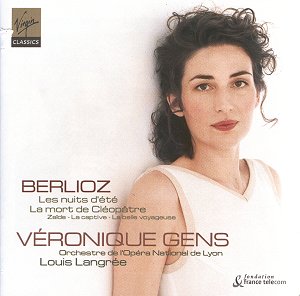
Hector Berlioz (1803–69) Les nuits d’été, La mort de Cléopâtre, La captive, La belle voyageuse, Zaïde Véronique Gens (soprano) Lyon National Opera Orchestra / Louis Langrée Recorded at Opéra National, Lyon (January 28–29, 2000, La mort de Cléopâtre), and — Auditorium Maurice Ravel (February 1–3, 2001, remaining works) Virgin Classics VC5 45422-2 [61:17] (DDD) — Listening to Véronique Gens in this set is like entering a perfume shop where every scent is perfectly calibrated—not overwhelming, not faint, but just right. It’s a rare thing, this marriage of immaculate French diction with expressive freedom; Gens doesn’t simply enunciate Les nuits d’été—she inhabits them. One can scarcely imagine a more persuasive French soprano in this repertoire today.
The comparison with Régine Crespin or Janet Baker, two legendary figures, is not mere flattery. It’s a recognition that Gens’s nuanced phrasing and tonal subtlety rank her among these giants. Her voice is lithe but not insubstantial—this is no fragile butterfly fluttering from phrase to phrase.
Rather, the Villanelle in Les nuits d’été bursts with a youthful joie de vivre, buoyed by Langrée’s graceful tempi. The orchestra’s strings leap and shimmer, as if spring itself were breathing through the music. Yet, the very next song, “Le Spectre de la rose,” shows Gens’s command of Berlioz’s darker shadows.
That moment, “j’arrive de Paradis,” so often trotted out as a showpiece, here feels like an ecstatic whisper carried on the edge of breath. She floats it with a delicate control that’s thrilling—an almost supernatural lightness without loss of warmth. There is a marvelous elasticity at work in her voice.
It stretches from the nuanced to the dramatic with subtle shifts, a palette of colors rather than blunt instruments. Listen to the opening of “Sur les lagunes,” where she darkens the tone; with a kind of mournful intimacy—those anguished “Ah!”s are true cries, raw and uncontrived. The players under Langrée does more than accompany.
It dialogues, often highlighting Berlioz’s modernist tendencies—especially in “Au cimetière” and — well — “L’île inconnue.” The latter’s impetuosity bursts forth in the strings, with a springboard-like articulation that feels spontaneous, yet meticulously crafted. The engineering by Pierre-Antoine Signoret deserves a mention here—each upward string surge in the final song is captured with crystalline clarity, as if you’re right there in the concert hall. Turning to La mort de Cléopâtre, we step into a different realm—the opera’s somber, almost spectral, atmosphere unfolds with orchestral textures both rich and chilling.
This work, predating Les Troyens by decades, anticipates Berlioz’s tragic vein with haunting prescience. The opening alone—a slow, measured orchestral prelude—sets a tone of inexorable fate. Gens’s Cleopatra is not merely a figure of despair; there is pride and defiance interwoven in her recollections.
When she recalls her triumphant entrance on the banks of the Cydnus, the vibrancy in her voice contrasts heartbreakingly with the impending doom. Her evocation of “eternal night” just before the Méditation is bleak to the; point of being almost tactile—one can feel the cold dark pressing against the music. The recitative-like passages reveal the full extent of Gens’s interpretive gifts.
The warm acoustics of the concert hall seem to breathe through the disc.
Each syllable is weighted with emotional substance, never rushed or thrown away. It’s a rendition that commands attention without shouting, drawing the listener into Cleopatra’s thoughts in a way that is both intimate and grand. The Lyon orchestra, for its part, matches this intensity and subtlety — with Langrée’s baton guiding the ensemble through Berlioz’s complex scoring with assurance and sensitivity.
This La mort de Cléopâtre stands comfortably alongside Jessye Norman’s monumental recording with Barenboim—a high compliment indeed. The disc’s final three songs—La captive, La belle voyageuse, and Zaïde—might be dismissed as mere fillers on lesser releases, but here they feel essential…. La captive, with Victor Hugo’s text, is a lesson in stillness and restraint.
Berlioz’s daring use of silence punctuates the closing phrases with an almost painful beauty; Gens’s voice quivers with quiet sorrow, nothing more needed. La belle voyageuse brings a lighter air, a welcome breeze after such intensity. The brief Zaïde is a miniature tour de force: Spanish inflections leap out, with castanets lending the refrain a lively authenticity.
Gens’s vocal fireworks finish the album on a sparkling high note. This recording is a triumph—an intelligent, emotionally honest, and beautifully realized exploration of Berlioz’s song repertoire. It’s a reminder that Berlioz’s genius lies not just in his grand symphonies or operas but in these intimate gems where voice and orchestra converse with rare poetry.
Véronique Gens and — well — Louis Langrée, supported by the fine Lyon orchestra, have made a record that will endure, not simply because of technical excellence, but because of the soul they bring to the music. Decisively—this is Les nuits d’été and company at their most radiant and profound. A truly refined record.