
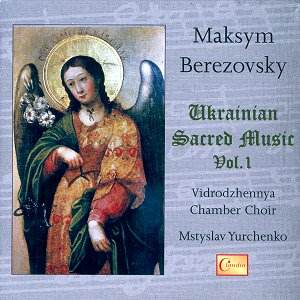
Maksym Berezovsky: Ukrainian Sacred Music, Volume 1
Vidrodzhennya Chamber Choir; Mstyslav Yurchenko, director.
Claudio CB 4730–2. Recorded at the Refectory Church, Kyiv. Compact disc, 63:39.
The historical record has been unkind to Maksym Berezovsky. We know tantalizingly little about a composer whose brief life—probably 1745 to 1777, though the dates remain disputed—encompassed achievements that should have secured him a more prominent place in the Russian musical canon. Born, according to legend, “to Cossacks in the town of Glukhov” in eastern Ukraine, he studied with Padre Martini in Bologna, wrote the first opera by a Ukrainian or Russian composer, and apparently took his own life at thirty-two. The elliptical sleeve notes here suggest suicide without quite saying so—a curious reticence given the tragedy’s historical significance.
What survives is fragmentary but revealing. This disc collects liturgical settings and choral concerts that reveal Berezovsky’s synthesis of Italian training and Ukrainian tradition. The fusion isn’t always comfortable, and that discomfort is part of what makes the music interesting.
Take the Credo from the Liturgy. Here’s remarkable, rapid homophonic chant—a spectacular piece that the Vidrodzhennya Chamber Choir navigates with conviction, though not without occasional strain. The writing draws on native Ukrainian traditions while bearing unmistakable traces of Berezovsky’s Italian apprenticeship. Published multiple times in Russia during the nineteenth and twentieth centuries, it evidently spoke to something in the Russian sacred tradition. You can hear why: the propulsive chant has an urgency that transcends mere devotional exercise.
“Meet It Is” offers different pleasures—a small masterpiece of expressive economy. Berezovsky’s word setting here shows the sure hand of a composer who understood how text and melody could illuminate each other. The Italian training equipped him with lyrical gifts, certainly, but the sensitivity to liturgical placement feels indigenous, rooted in Orthodox practice.
The Eucharistic Verses present a more challenging listening experience. Each consists of two stanza verses and an “Alleluia” refrain—a seemingly limited, even self-limiting form. Within these constraints, Berezovsky constructs compact polyphonic movements that reward close attention. “The Salvation Cup I Will Receive” showcases flexible basses embodying what was already, by the 1770s, a characteristic Russian tradition. The vocal writing here has real character.
But the performance doesn’t always serve the music ideally. “Joy for the Blessed,” a very short setting, exposes some wayward and exposed voices in the female choir. There’s bulging of the line elsewhere, particularly from the women, and occasional pitch uncertainties that a more rigorous preparation might have addressed. The recorded acoustic—the Refectory Church of Kyiv—provides ample resonance but perhaps too much forgiveness, masking problems that would be more apparent in a drier space.
The three settings of “Praise the Lord” show Berezovsky working variations on devotional affect. The third is the most propulsive, devotionally ecstatic, and least inward-looking—a telling progression that suggests the composer understood the dramatic possibilities of sequencing even within liturgical contexts.
“Let the Lord Enthrone,” one of only three surviving choral concerts by Berezovsky, closes the disc. The form suited him particularly well, allowing for more expansive treatment while maintaining liturgical propriety. It’s thematically uncomplex, but the singular sensitivity for word placement remains in evidence throughout. In four recognizable movements spanning barely six minutes, it reveals both Berezovsky’s gifts and the constraints within which he worked.
The absence of texts is a serious omission. How are listeners unfamiliar with Ukrainian liturgy supposed to follow the word setting that the notes rightly praise? It’s a puzzling editorial decision for a release claiming scholarly intent.
Still, this remains a revealing and welcome disc. Berezovsky emerges as a composer of genuine accomplishment, one whose synthesis of Italian and Ukrainian traditions produced music of real character. The Vidrodzhennya Chamber Choir, despite occasional technical shortcomings, performs with evident commitment and cultural understanding. One hopes volume 2 will address the textual lacuna—and that Berezovsky’s small but significant legacy will continue to receive the attention it deserves.
