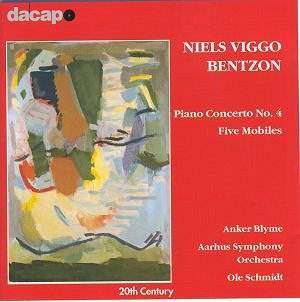
Bentzon: Piano Concerto No. 4 (1954) / Five Mobiles (1960)
Anker Blyme (piano) / Aarhus Symphony Ensemble / Ole Schmidt
Recorded live 1982, Kongreshuset Aarhus
Dacapo 8.224110 [59:46]
The leader’s presence feels palpable even in this studio setting.
Niels Viggo Bentzon’s Piano Concerto No. 4 emerges here as a rather fascinating hybrid—one that delicately balances on the precipice between tradition and — well — modernist exploration.
Premiered by the composer himself under Erik Tuxen’s baton in 1954, this concerto reveals Bentzon grappling with the — ghosts of Beethoven yet filtering them through a mid-century lens tinted by Berg’s lyricism and Stravinsky’s propulsive rhythms. The recording at hand, with Anker Blyme at the keyboard and Ole Schmidt conducting the Aarhus SO, captures a vivid if occasionally uneven personality within the work. The first movement commands attention from the outset—not with a bold statement but with a taut, almost anxious restraint.
Bentzon’s Beethoven is not the heroic thunderclap but rather the brooding, almost hesitant spirit one finds in the Coriolan Overture or the introspective shadows of Beethoven’s Third Concerto. Blyme’s touch here is incisive, his articulation crisp without ever feeling brittle, navigating the concerto’s jagged rhythmic contours with a kind of nervous elegance. The orchestral backdrop—lean and transparent under Schmidt’s direction—allows subtle Bergian undertones to ripple through the texture, especially in those moments of hesitant lyricism that recall Berg’s own Piano Concerto.
One cannot ignore the way rhythmic energy is channeled through the orchestra with a; nod to Stravinsky’s neoclassical bite, particularly in the "scherzo"-like vitality that bubbles beneath the surface. Yet the movement’s closing moments introduce an unexpected tonal warmth; a hint of Vaughan Williams’s ‘bruising’ pastoral quality seeps in—an elusive, wistful echo rather at odds with the earlier tautness, yet oddly compelling. Blyme’s pedal work here adds a shimmering resonance, evoking a kind of distant landscape half-remembered.
The "Adagio" is a slow bloom, improvisatory and sardonic in its unfolding. Bentzon’s writing here is less concerned with formal cohesion and more with mood—an almost Shostakovich-like wariness pervades, a sense that beneath the rhapsodic surface, there lies a hard edge, a quiet irony. Blyme’s phrasing is sensitive, though at times the pacing feels a little too elastic, threatening to dissipate the tension rather than deepen it.
Still, the bell-like descents that punctuate the movement—those crystalline motifs—linger in the ear, their resonance carrying forward into the "finale". The "finale" bursts forth with rhythmic abundance, a frenetic energy that recalls the angular precision of Five Mobiles, Bentzon’s 1960 suite for piano and orchestra. These miniatures—especially the second and third—offer a fascinating complement to the concerto.
The second mobile is tinged with nihilism, the abyss seeming to yawn beneath its terse gestures, while the third floats jaggedly jewel-like, barely tethered to tonality, harkening back to Holst’s Neptune or even the cosmic wanderings of Ode to Death. Blyme’s touch is deft, navigating these shifting tonal shards with crystalline clarity, though at the expense occasionally of warmth. That said, the fifth mobile slows the heart considerably—almost to a crawl—with a chorale that feels overextended, its affectation of suspended animation somewhat grating after the suite’s earlier urgency.
One wonders if the inspiration—the suspended mobiles of Alexander Calder—was perhaps a conceptual constraint here, imposing a stillness ill-suited to music so charged with kinetic energy elsewhere. Bentzon’s prodigious output—operas, symphonies, 25 piano sonatas, fourteen string quartets—makes the relative scarcity of piano concertos until his forties all the more surprising. Yet in this Fourth Concerto, despite occasional shortcomings, one hears a composer earnestly negotiating his identity amid towering influences, sometimes stumbling but never faltering in purpose.
The Aarhus SO under Schmidt, for the most part, provides a lucid, responsive canvas though the disc’s somewhat dry acoustics deny the orchestra’s inner warmth. In sum, this account of Piano Concerto No. 4 and — well — Five Mobiles offers a window into Bentzon’s restless creative spirit—a blend of classical reverence and modernist experimentation that, while uneven, is undeniably arresting.
Blyme’s interpretation is alert, occasionally brilliant, yet the interpretive choices sometimes verge on over-intellectualized detachment. For those willing to engage with Bentzon’s idiosyncratic voice, this Dacapo release remains a compelling, if imperfect, invitation. Highly recommended—not as a seamless masterpiece but as a vital document of mid-century Scandinavian modernism wrestling with tradition.