
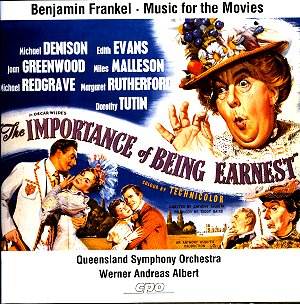
Benjamin Frankel: Film Music Vol. 2
Queensland Symphony Orchestra / Werner Andreas Albert
CPO 999 809–2 [67:13]
The curious thing about Benjamin Frankel—and there were many curious things about him—is how completely he vanished from view after his death in 1973, only to resurface decades later as one of the most consistently interesting British composers of his generation. This second volume of film music from CPO confirms what the first suggested: that Frankel brought to commercial cinema a compositional intelligence that never condescended to the medium.
The selection from The Importance of Being Earnest (1952) opens the disc with a delightful surprise. Someone—Frankel himself, perhaps, or an enterprising BBC arranger—fashioned these cues into a miniature overture that tips its hat to Offenbach with such affection you can almost hear the composer smiling. It’s utterly charming stuff, full of wit and perfectly turned phrases. Light music, yes. But light music written by someone who knew exactly what he was doing.
Then we shift abruptly into darker territory. The “Pastoral” from The Curse of the Werewolf (1961) stands as an oasis of tonality in what was apparently the first atonal film score ever written—a claim I haven’t verified but find entirely plausible given Frankel’s modernist credentials. This brief tone poem recalls Honegger’s Pastorale d’été in its luminous string writing, though Frankel’s harmonic language is distinctly his own. Werner Andreas Albert draws some genuinely exquisite playing from the Queensland strings here, with that particular glow that suggests musicians who actually care about what they’re doing.
The Night of the Iguana (1964) occupies the disc’s center, and rightly so. This is Frankel at his most accomplished—spare, tense, psychologically acute music for John Huston’s film of Tennessee Williams’s play. The scoring is economical, almost ascetic at times, which makes the sudden appearance of “Mexican Washer Women” all the more effective. Frankel understood film dramaturgy better than most: when to pull back, when to comment, when to simply let silence do its work. The darkness here is genuine, not Hollywood darkness. Burton, Gardner, and Kerr got the score they deserved.
Trottie True (1949) returns us to Frankel’s lighter mode—the “Gaiety Galop” bounces along with infectious energy, and “Trottie True Trot” is indeed a near-cousin to the celebrated “Carriage and Pair” from So Long at the Fair. These are tunes you find yourself humming hours later, which is no small achievement. Frankel had facility, that dangerous gift that can lead to mere slickness. He rarely succumbed.
The Lullaby from The Years Between (1946), arranged by Dimitri Kennaway for strings, is a small gem—originally written for piano and played in the film by Eileen Joyce. It’s touching without sentimentality, which is harder than it sounds.
Footsteps in the Fog (1955) presented Kennaway with formidable challenges. Little of the original score survived, and he reconstructed roughly half of it by listening repeatedly to the soundtrack—detective work that deserves recognition. What emerges is another predominantly serious score, though “Drive in the Countryside” provides welcome relief from the prevailing tension. The “Lily Watkins Theme” is genuinely beautiful; “Lowry’s Secret” appropriately sinister.
Albert and the Queensland players serve this music with consistent intelligence and care. The sound from ABC Studio 420 in Brisbane is clean and well-balanced, if perhaps lacking the last degree of warmth one might want for some of these scores. But that’s a minor quibble.
CPO’s commitment to Frankel—following their outstanding Battle of the Bulge album—puts them in our debt. This isn’t music for film buffs only, though they’ll certainly want it. It’s music for anyone interested in how a first-rate compositional mind addressed the particular challenges of cinema. Frankel never stopped being a serious composer when he wrote for films. That’s the point, really. He couldn’t have if he’d tried.
