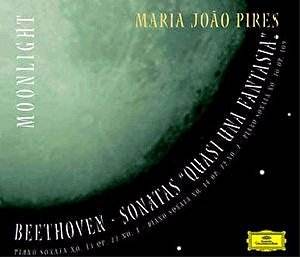
Ludwig van Beethoven
Piano Sonatas Nos. 13 in E flat, Op. 27 No.
1; 14 in C sharp minor — Op. 27 No. 2 (“Moonlight”); 30 in E, Op.
109
Maria João Pires, piano
Recorded at Granja de Belgais, Portugal, June 2000 and May 2001 [DDD]
DG 453 457-2; 51:16 minutes
There are recordings one returns to not because they reinvent the wheel but because, quietly — they show you the wheel turning in a way you hadn’t quite noticed before. Maria João Pires’s Beethoven sonatas disc—featuring the Op. 27 pair alongside the late Op.
109—is that rare sort of encounter. It’s not hyperbole to say that she inhabits these pieces with a kind of intimacy that feels… well, unforced,; natural, as if she’s simply whispering Beethoven’s thoughts to you in a language you almost understand without trying too hard. The packaging itself sets a tone—elegant, restrained.
Quotes from Rilke, Hesse, and Furtwängler nestle alongside pastoral photographs of Belgais, Pires’s Portuguese artistic retreat. One wonders if the abundance of literary adornment is quite necessary; Pires’s playing communicates the spirit of Beethoven far more compellingly than any epigraph could. This is a disc that lives and breathes in the space between the notes.
Take the Piano Sonata No. 13 in E flat, Op. 27 No.
1. Often overshadowed by its famous sibling, this sonata is a gem that Pires unveils with lyrical clarity and subtle dynamism. Her "Adagio" con espressione is suffused with a gentle yet searching pathos—phrasing just long enough to avoid sentimentality but deeply human all the same.
The "Allegro" molto e vivace second movement crackles with an irrepressible vitality, articulated with a crystalline precision that never sacrifices warmth. And the "finale"’s unfolding—yes, the fingerwork is impeccable—but what stays with me is the balance she strikes between clarity and expressive depth, as if the sonata’s architecture is being built in real time before your ears. Now, the Moonlight Sonata—that ever-mythologized beast.
Pires approaches its first movement with what feels like a preternatural calm; she invites you into a world where each repeated triplet and sonorous bass note lingers like a breath held just a little too long. There’s a stillness here that’s almost meditative, yet it’s anything but passive. Many have battled this movement, wrestling with its melancholy; Pires, by contrast, seems to inhabit it effortlessly.
The final movement, predictably, eschews Pollini’s edge-of-your-seat fireworks. Her approach is more measured—explosive where it must be, but allowing the music’s lyrical moments to breathe and resonate, underscoring Beethoven’s complex emotional narrative rather than mere virtuosity. Op.
109 stands as a fitting capstone, a late Beethoven masterpiece where transcendence and earthiness collide. The opening movement is dignified, the cantabile singing through Pires’s hands with a natural eloquence. A notable moment arises in the second movement, where she hardens the tone just enough—deliberately—highlighting Beethoven’s emphatic gestures without ever losing the sonata’s overarching lyricism.
The final movement is where Pires’s artistry truly shines: the architecture of this sprawling set of variations is realized with a kind of; inevitability, each subtle shading and shift in texture pulling the listener into the late Beethoven universe—robust, contrapuntal, yet suffused with a celestial glow. The trill passages and the restatement of the theme in a transfigured light reveal not only technical mastery but profound insight. If one must nitpick, there are moments—particularly in Op.
27 No. 1—where the bass sounds slightly muddy, the disc’s balance less than ideal. But these are rare occasions, and in no way detract from the overall — soundscape, which is otherwise warm and immediate, with a remarkable sense of space.
In sum, this disc is a reminder of what makes Maria João Pires a instrumentalist of unique calibre: her ability to communicate Beethoven’s music with a sincerity and subtlety that transcends mere notes on a page. These sonatas are not just performed; they are lived, breathed, and artfully reimagined in every phrase. A disc to cherish, compare, and return to—one that stands alongside the finest of DG’s Beethoven releases, alongside Pollini’s more overtly virtuosic renditions, yet utterly distinct in its poetic repose.
A truly awe-inspiring offering. One hopes Pires keeps sharing this rare gift for many years to come.