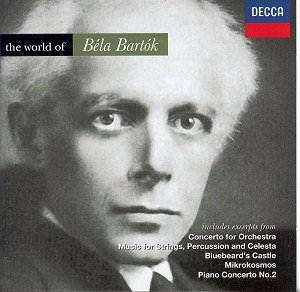
Béla Bartók (1881–1945): The World of Béla Bartók
Detroit Symphony Orchestra/Antal Dorati; Vladimir and Vovka Ashkenazy (pianos), David Corkhill and Andrew Smith (percussion); Walter Berry (Bluebeard), Christa Ludwig (Judith); London Symphony Company/István Kertész; Zoltán Kocsis (piano); Vladimir Ashkenazy (piano); London Philharmonic Orchestra/Sir Georg Solti; Chicago Symphony Orchestra/Sir Georg Solti; Arvid Engegard (violin), Elmar Schmid (clarinet), András Schiff (piano)
DECCA 470 129 2 [73.00] (1966–1994 recordings)
Decca’s The World of Béla Bartók compilation slips into the CD market with a somewhat familiar itch—short movements snatched from larger wholes, a mosaic of Bartók’s vast landscape rather than a panoramic vista. The temptation to dismiss this as mere “sampler fodder” is real; after all, the composer’s works breathe as complete entities, and there’s a risk here of reducing his sprawling architectural logic to mere fragments. But—and it’s a hefty but—this release, at an accessible price, offers a doorway, if a slightly ajar one, into Bartók’s multifaceted sound world.
One must start with the performances. The Chicago Symphony under Sir Georg Solti, a director who had an almost symbiotic relationship with Bartók’s idiom, delivers the Elegia from — Concerto for Orchestra and the Allegro molto from Music for Strings, Percussion and Celesta with a razor-sharp edge and shimmering tonal palette. There’s a visceral intensity in Solti’s reading that captures Bartók’s rhythmic propulsion without sacrificing the eerie nocturnal shadows implicit in the scoring.
The Elegia, in particular, —with its slow, dolorous lines unfolding amid dark woodwind hues—reveals Solti’s keen ear for instrumental color and textural layering. Yet the selection itself feels puzzling. Why the slow movement from the Piano Concerto No.
2 (Vladimir Ashkenazy, London Philharmonic) next to the first movement of the Sonata for Two Pianos and Percussion (Dorati, Detroit Symphony Orchestra)? This patchwork approach undermines the narrative momentum inherent in the original cycles. Bartók’s architecture is often about contrast and resolution over extended spans; here, those arcs are truncated, leaving the listener with isolated peaks but few valleys.
Had Bartók intended these movements as standalones, he might have structured them differently, perhaps less episodically. Still, the jewel in this trove is Zoltán Kocsis’s interpretation of Mikrokosmos Book VI, Nos. 148–153.
These short piano pieces, often overshadowed by the composer’s grander works, receive a nuanced, idiomatic execution—each figure — articulated with crystalline clarity and — well — folk-inflected rhythmic vitality that hints at the source materials underpinning Bartók’s style. Kocsis’s touch is both tender and assertive; one can almost hear the Hungarian peasant dances and children’s songs filtered through a modernist prism. It’s a reminder that Bartók’s genius lies not merely in orchestral fireworks but in his intimate engagement with vernacular traditions.
The recordings themselves span decades, from Kertész’s 1960s Bluebeard’s Castle with Walter Berry and Christa Ludwig—still remarkably vibrant and atmospheric—to more recent Solti sessions. The sound quality is mostly excellent, preserving the warmth of period instruments and the clarity of modern digital remastering, except for the Dorati Suite No. 1, Opus 3, for which disc dates are frustratingly absent—its sonic character suggests the mid-60s, with a slightly dry,; direct microphone placement that places percussion front and center, sometimes a touch too clinical for the music’s subtle tensions.
There’s a certain irony that the very strength of these individual performances accentuates the compilation’s weakness. One longs for the full Concerto for Orchestra or Music for Strings, Percussion and Celesta to fully absorb the ebb and flow of Bartók’s orchestral rhetoric. Instead, the listener is left assembling puzzles with missing pieces—the rapid, grainy Fast Dance from Contrasts (Engegard, Schmid, Schiff) is charming but brief, lacking the narrative context that would make it more than a curiosity.
In sum, The World of Béla Bartók is a mixed blessing. It offers outstanding performances by artists deeply connected to the composer’s idiom, ideal for newcomers or those seeking a sampler of his varied textures and moods. But for the initiated or the serious student, this patchwork approach—while sometimes illuminating—feels like an incomplete conversation with a composer who demands total commitment.
Bartók’s music rewards immersion; here, it is punctuated and paused, the full story tantalizingly withheld. If you want to begin your Bartók journey—or need a handy reference—it is worth owning. But for those who cherish his profound journeys in full, seek out the complete recordings by Solti, Kertész, and Kocsis elsewhere.
That particular brightness of period instruments catches the ear.
Only then can you fully inhabit the world Bartók so insistently and uncompromisingly created.