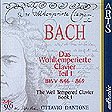
Johann Sebastian Bach (1685–1750)
Well-Tempered Clavier, Book I BWV 846–869 [123:49]
Well-Tempered Clavier, Book II BWV 870–893 [146:04]
Ottavio Dantone, harpsichord
Recorded June 2000, Sala del Refettorio di S. Vitale, Ravenna, Italy
ARTS MUSIC 47654-2 (Book I), 47657-2 (Book II)
Ottavio Dantone’s Well-Tempered Clavier—a two-book set realized on a splendid Olivier Fadini copy of a Blanchet harpsichord—arrives with a freshness that jolts you from the usual, often reverential, approach. This is not Bach played as a dusty relic.
No, Dantone throws down the gauntlet with a little trill at the end of the opening prelude—an impish gesture, unexpected yet oddly fitting, signaling a performer ready to engage in a vivid conversation with this monumental work. The instrument’s voice immediately commands attention. Its treble shimmers—bright, but never brittle—while the bass notes knit a warm, resonant fabric beneath.
The production captures not just the instrument but the space itself: a high-ceilinged refectory in Ravenna — with microphones placed just so, yielding a tactile immediacy rare on harpsichord discs. You almost feel you could reach out and touch the keys. The resonance is subtle, never bloated, enhancing the harpsichord’s articulate clarity without blurring its crispness.
Dantone’s choice of temperament offers a fascinating glimpse into his musical mind: Book I employs Werckmeister III, Book II Kirnberger—a shift that’s more felt than overtly heard, yet one wonders at the psychological effect this has on the listener, a subtle change in tonal color and tension. It’s a reminder that Bach’s tuning systems were never monolithic, and Dantone, in subtly privileging this, invites us to listen anew, to hear the Well-Tempered not as an abstraction but as a living, breathing experiment in sound. Stylistically, he is anything but formulaic.
The E minor prelude from Book I is a case in point: Dantone’s tempo leans slightly forward, a quicksilver dance between the voices that brings out the contrapuntal interplay with crystal-cut precision. The arpeggiating bass is lively, a pulse underpinning but never overwhelming the sprightly treble line—it’s a; sunny, almost playful articulation, which feels a little brighter than, say, András Schiff’s more meditative renditions. Yet he can also be muscular.
The F minor fugue from the first book has a punch and bite—each voice delineated sharply, almost aggressively, crisply detached but never mechanical. Contrast that with the delicacy of the F-sharp minor pair, where his touch is feather-light, a whisper of sound that holds its shape perfectly without sacrificing warmth. There’s a flexibility here that speaks of a deep understanding of Bach’s shifting affect—his playing bends to the character demanded by each piece, never imposing a single temperament or mood.
Ornamentation is judicious, never indulgent. Take the long trills in the G minor prelude of Book I—Dantone plays them at a tempo that allows each to sing, rather than rattle on endlessly as they sometimes can, preserving their expressive intent without gratuitous flash. It’s this balance—between expressive freedom and stylistic restraint—that marks him out as a harpsichordist of real insight.
Book II opens with a markedly tender account of the C major prelude. Too often this piece is hurried, clipped, or, worse, overblown; here, there’s a humility to Dantone’s approach, a sense that the music’s inherent lyricism is allowed to bloom naturally. His ornamentation in the following C-sharp major prelude sparkles with freshness—a kind of effortless charm that feels entirely appropriate rather than showy.
The fugue that follows, while structurally rigorous, is imbued with a subtle joie de vivre that many performances miss entirely. One might detect a faintly ‘French’ flavor—if one can talk of such coloration in Bach—especially in the F minor — prelude of Book II, where slightly détaché articulation and a “precious” touch shape the phrases with elegance and finesse. Rhythms are incisive, never mechanical; phrases breathe, and the counterpoint is spun out with enviable clarity.
The fugues impress particularly in their transparency—each voice disentangled yet contributing to an; organic whole—rarely do you hear the Well-Tempered Clavier played with such joyous assurance. Dantone’s approach is far from the dry academicism that can plague harpsichord performances of this cornerstone repertoire. There is vigor here, yes—but also tenderness, wit, and a palpable joy.
This is music lived and loved, not merely studied and played. In sum: this set ranks among the finest harpsichord recordings of the Well-Tempered Clavier available. The union of a superb instrument, an inspired performer, and an elegant recording creates a listening experience that feels both intimate and expansive.
Dantone’s interpretation is marked by a rare combination of scholarly respect and personal voice, and it leaves you eager for what he might do next. A truly indispensable addition to any harpsichord lover’s collection.