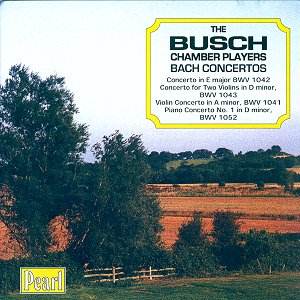
J.S. Bach: Violin Concertos BWV 1041, 1042, 1043; Piano Concerto No. 1 BWV 1052
Adolf Busch, violin and director; Eugene Istomin, piano; Frances Magnes, violin; Busch Chamber Players
Recorded New York, 1942-1945
Pearl GEMM CD 9298 [72:47]
This disc ought to be essential.
It very nearly is. Adolf Busch’s American years have never received their due—scattered reissues, muddy transfers, the usual depredations of time and neglect. Pearl has done honorable work here, gathering performances from the early 1940s that reveal; a profoundly musical intelligence at work, even when the sound occasionally betrays its age.
What we hear is Busch’s Bach stripped of late-Romantic excesses yet never merely antiseptic, a middle path that now seems prescient but must have sounded eccentric in an era when Kreisler’s portamentos still hung heavy in the air. The Concerto in E Major, BWV 1042, proves everything admirable about Busch’s approach. Heavy bass accents, yes—the acoustic is resonant to the point of overloading in spots, and — well — modern ears may flinch.
But listen to the expressively heightened playing at 5:04 in the first movement, or better yet, notice what Busch doesn’t do at 3:30 in the "Adagio". Where his contemporaries inserted Bruchnerian luftpausen—great gasping pauses that shattered the line—Busch maintains architectural integrity. The movement emerges whole.
His slides are precise, tasteful, never mawkish. Artur Balsam’s continuo is so distantly recorded one suspects Busch wanted it that way, a barely audible harmonic foundation rather than a partner. (Mieczyslaw Horszowski suffers similar treatment in Busch’s Handel recordings—clearly a matter of preference, not accident.)
The Double Concerto with Frances Magnes faced formidable competition in 1945: memories of Szigeti and Flesch, of Menuhin and Enescu, the Rose duo.
Busch and Magnes offer something different—romanticized, certainly, reaching peak expressivity in the "Largo" where Magnes’s subordinate voice provides sympathetic support without effacement. The "finale"’s thunderous bass accents are harder to defend. They’re excessive — frankly, though one learns to listen past them to the musical intelligence beneath.
Then there’s the live A minor, BWV 1041, from Town Hall in 1943, preserved on acetates by Busch’s widow. The sound is constricted — occasionally desiccated—you can hear where the violin tone thins out in the upper register, made worse by the release. Yet the flexibility of Busch’s line remains uncanny.
His dynamic and metrical sophistication argues for itself, though some tempo relationships feel stodgy by modern standards. A few acetate thumps intrude. No matter.
Lukas Foss’s continuo is more audible than Balsam’s, supporting Busch’s devoted phrasing with actual presence. Eugene Istomin was young when he recorded the D minor Piano Concerto, BWV 1052—twenty-something and technically secure. The realization is robust, forthright, with even trills and splendid passagework.
The leader’s presence feels palpable even in this studio setting.
It’s never quite deep enough. Istomin plays the notes beautifully but hasn’t yet found what lies between them. Still — as a document of youthful virtuosity partnered with Busch’s direction, it has considerable value.
Now the unforgivable part: there is often no more than one second’s gap between movements. Sometimes less. The E major Concerto’s "Adagio" bleeds into the "Allegro" assai with scarcely a breath.
The Double Concerto fares no better. Did no one at Pearl listen to this before pressing? It’s maddening—these performances deserve better than to be jammed together like rush-hour commuters.
The music needs space to resonate, the listener needs time to absorb. This should have been a desert-island disc. It’s merely an essential one marred by inexcusable production decisions.
Pearl must repress this immediately with proper spacing. Until then, we have a fascinating historical document that requires more tolerance than it should. Busch’s artistry survives the indignities inflicted upon it, but only just.