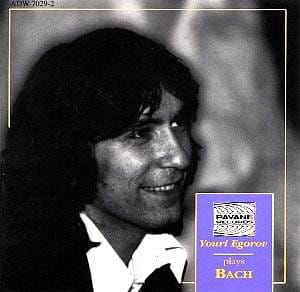
BACH: Preludes and Fugues from The Well-Tempered Clavier, BWV 850, 857, 869; Italian Concerto, BWV 971
Youri Egorov (piano)
Pavane ADW 7029 [37:07]
There’s something haunting about posthumous recordings—not just the inevitable elegiac frame they impose on our listening, but the way they force us to evaluate fragments, glimpses of what might have been. Youri Egorov, who died in 1988 at thirty-three, left behind tantalizing evidence of a major artist. This 1983 Bach recital (the liner notes get the date wrong, naturally) offers both confirmation and frustration in equal measure.
The B minor Prelude and Fugue stops you cold. Egorov takes it at a tempo so glacial, so utterly removed from conventional Bach performance practice, that the opening bars feel like watching continental drift. Over seventeen minutes for a piece that typically runs nine or ten—this is interpretive audacity bordering on perversity. The harpsichord, Bach’s intended medium, simply couldn’t sustain such tempos; the notes would evaporate. But on the modern piano, with its capacity for infinite dynamic gradation and sustained legato, something strange happens. The music doesn’t collapse. Instead it achieves an almost narcotic intensity, each voice emerging with hallucinatory clarity from Egorov’s carefully calibrated pianissimo.
Listen to how he voices that opening—the left hand barely whispers its chromatic descent while the right hand’s suspensions hang suspended (forgive the redundancy) like drops of water refusing to fall. It’s mannered, yes. Possibly indefensible from a stylistic standpoint. And absolutely mesmerizing.
The fugue intensifies this vision rather than dispelling it. Egorov traces each entry with the concentration of someone illuminating a medieval manuscript, never hurrying, never losing the thread even as the counterpoint grows dense. One thinks of Gould’s eccentricities, though Egorov’s sensibility is warmer, less astringent. Whether Bach would recognize his own music in this performance is debatable. Whether he’d admire the sheer architectural control Egorov brings to bear—that seems likelier.
After such rarefied air, the Italian Concerto feels almost breezy. Here Egorov adopts more conventional tempos, though his articulation remains distinctive—crisp without brittleness, the left-hand orchestral tuttis genuinely orchestral in their weight and color. The slow movement sings with genuine pathos, the ornamentation tasteful if not particularly adventurous. He understands that this is Bach at his most galant, writing music that looks toward the pre-classical style of his sons, and he responds with appropriate grace.
The two remaining preludes and fugues—D major and F-sharp major—receive similarly thoughtful if less radical treatment. Egorov’s touch throughout reveals careful study; his sense of harmonic direction never falters. The recorded sound captures the piano (sounds like a Steinway, though documentation doesn’t specify) in a pleasing acoustic that allows for genuine piano playing rather than the close-miked, note-perfect but airless sound that plagued so many early digital recordings.
But now we come to the problems, and they’re substantial enough to sink the disc as a viable recommendation. Thirty-seven minutes. In an era when most recitals run seventy-plus, this feels miserly—particularly given that Pavane is asking full price. The absence of separate tracks for individual movements of the Italian Concerto or for each prelude and fugue suggests production standards that were questionable even in the early CD era. And the documentation… well. A biographical sketch riddled with typos and grammatical howlers, zero program notes, no release details beyond a studio name. One suspects this was assembled on the cheap, trading on Egorov’s name and tragic early death.
Which brings us to the uncomfortable question: how do we evaluate such a release? The B minor interpretation alone justifies the disc’s existence as a document of a singular interpretive vision. But can one recommend a poorly produced, absurdly short, inadequately documented disc, even when it contains such remarkable music-making?
The answer, reluctantly, must be no—at least not as a purchase. Seek it out if you’re already deep into Bach piano literature, if you’re curious about Egorov’s artistry, if you want to hear just how far one can stretch Bach’s rhythmic and temporal boundaries without breaking them. But as an introduction to either the music or the pianist? Look elsewhere. Schiff, Hewitt, Perahia—any of these will serve you better, with complete books, proper documentation, and performances that honor Bach without disappearing into interpretive rabbit holes.
Still, I keep returning to that B minor Prelude in my mind. Strange, willful, possibly wrong-headed—and unforgettable.