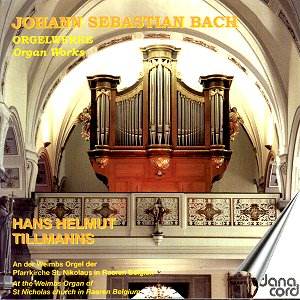
Johann Sebastian Bach (1685–1750)
Organ Works: Prelude and Fugue in A Minor, BWV 543; Prelude and Fugue in E Minor, BWV 536; Partita “O Gott, du frommer Gott”, BWV 767; Allabreve, BWV 589; Prelude in G Major, BWV 568; Pastorale in F Major, BWV 590; Choralvorspiel und Choral, BWV 604
Hans Helmut Tillmanns, organ
Recorded October 2001, St Nicholas Church, Raeren, Belgium
Label: Danacord DACOCD 590 [67:04]
There’s something quietly commanding about Hans Helmut Tillmanns’s latest survey of Bach organ works, a recording that might strike some as reserved—or, if you will, patrician in its restraint. But that’s precisely where its merits lie. A pupil of Helmut Walcha, Tillmanns brings to this repertory a refined sense of structure and voice-leading that refuses to be rushed.
The Weimbs organ at Raeren, dating from 1994, suits him well: its clear, reedy flutes and crisply defined principals lend the textures a crystalline clarity that Danacord’s engineers have caught with remarkable fidelity. The acoustics of St Nicholas Church offer just enough resonance to colour the sound without blurring the contrapuntal lines—an essential balance for Bach’s organ music. The recording opens with the Prelude and Fugue in A Minor, BWV 543, a cornerstone of the Bach organ repertoire that demands both architectural breadth and nimble articulation.
Tillmanns does not go for flamboyance here; instead, he opts for an approach that’s measured but never dull. The prelude’s throbbing pedal points and逐渐升起的音阶 are delivered with a solidity that anchors the music, while the fugue’s three-part counterpoint is neatly delineated. His voicing of the fugue subjects is crisp—never muddy—allowing each entry to speak clearly.
It’s the sort of rendition that rewards close listening rather than immediate dazzlement. In the Prelude and Fugue in E Minor, BWV 536, Tillmanns’s articulation shines, particularly in the — fugue’s episodic passages where his fingerwork deftly negotiates the complex figurations without losing the harmonic thread. The balance between manuals is meticulously calibrated, and his registrations—though subtle—bring out the distinct timbres of the Weimbs organ stops.
The Partita “O Gott, du frommer Gott” BWV 767, often overlooked, receives an elegant, devotional reading. There’s a devotional quality here, a reverence that avoids sentimentalism but invites reflection, a rare feat. The Allabreve, BWV 589 and Prelude in G Major, BWV 568 further reveal Tillmanns’s insightful grasp of baroque rhythm and phrasing.
The Allabreve moves with a supple lightness, its dance-like character preserved but never exaggerated. The Pastorale — BWV 590, a lovely, lyrical interlude, is played with warmth and a gentle swelling that never becomes excessive. What stands out is the subtle gradation of dynamics—an art too often neglected in organ recordings—where Tillmanns carefully shapes phrases through touch and registration changes.
One cannot overlook the Choralvorspiel und Choral, BWV 604, where the organ’s reed stops come into their own. Here, the registration choice is inspired: the reedy tone contrasts beautifully with the otherwise more flutelike textures elsewhere on the disc. Tillmanns’s tempo is measured, allowing the chorale melody to emerge with clarity and dignity, while the accompaniment is voiced to support without overwhelming.
The booklet, regrettably, offers little in the way of commentary on the individual works, which is a missed opportunity given the disc’s thoughtful programming. Still, the half-page devoted to the organ builders Weimbs provides useful context about the instrument’s tonal design and — well — mechanical action, which, as one hears, is remarkably responsive. Listening to this disc, one is reminded that Bach’s organ music is as much about architecture and clarity as it is about display.
Tillmanns’s approach might not satisfy those seeking virtuosic pyrotechnics or flamboyant registration changes, but it offers an intelligent, musically thoughtful alternative—a recording that invites you to settle in, to hear the contrapuntal lines weave and interlock with precision and grace. In sum, this is a disc that commands respect for its integrity and musicianship. It may not spark immediate excitement for all, but it rewards patient listening; with the kind of insight and subtlety that Bach’s organ works so richly deserve.
You can almost hear the rosin dust settling on the strings.
Recommended for those who cherish a measured, scholarly approach, and for aficionados of the Weimbs organ’s distinctive voice.