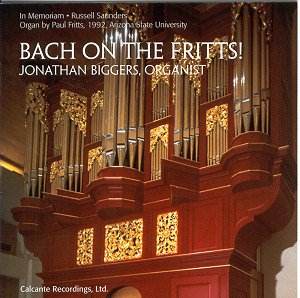
Johann Sebastian Bach: On The Fritts!
Organ Works: “Toccata, "Adagio" and Fugue in C-Minor” BWV 564, Partita on ‘Sei gegrüsset, Jesu gütig’ BWV 768, Prelude and Fugue in A-Minor BWV 543, Prelude and Fugue in A-Major BWV 536, Chorale Prelude “Schmücke dich, o liebe Seele” BWV 654, Chorale Prelude “Wenn wir in höchsten Nöten” BWV 668a, Passacaglia in C-Minor BWV 582
Jonathan Biggers, Organist
Organ by Paul Fritts and Co., 1992, Arizona State University, Temple, Arizona
Recorded May 1994
Calcante Recordings CAL CD009 [77:01]
This disc, a somewhat curious venture into Bach’s organ oeuvre, attempts to harness the vivid palette of a contemporary instrument designed in the archaic Dutch-North German tradition – a Paul Fritts organ echoing the spirit of Arp Schnitger’s monumental craft. The space, a resonant chapel at Arizona State University with its long reverberation tail, promises clarity and majestic sonority. Yet, paradoxically, much of what Jonathan Biggers offers here wanders into a mist of blurred articulation and somewhat tepid registration choices.
Right out of the gate, the Toccata, Adagio and — well — Fugue in C-Minor (BWV 564) — a work that’s as much a fantasia on the Italian concerto as a model of organistic innovation — suffers from a puzzling registration that smothers the pedal line. The bass descends into a muddy morass rather than providing the solid contrapuntal foundation that Bach’s architecture demands. The pedal is the heartbeat here; if it lacks definition, the entire edifice wobbles.
The warm acoustics of the concert hall seem to breathe through the disc.
Biggers’ slow, somewhat hesitant articulation fails to wrestle control of the room’s echo, and what should — be crisp dialogue between manuals and pedal becomes a blurred breath, lost in the cathedral’s generous acoustic. Contrast this with the Partita on ‘Sei gegrüsset, Jesu gütig’ (BWV 768). Bach’s longest chorale partita, eleven intricate variations, is a microcosm of his contrapuntal ingenuity and melodic invention.
Yet, this execution feels curiously dull, lacking the necessary contrast and vivacity. The organ’s manual reeds, a resource begging to be exploited for effective manual differentiation, remain underused, resulting in a bland sonic texture. The tempo choices across variations verge on indecisive, with too liberal a dose of rubato that leans toward a Romantic veneer, undermining the baroque clarity of Bach’s design.
Variation 1’s melismatic character is muffled rather than illuminated; variations 3, 6, and 8 reveal a blurred bass that detracts from the intricate interplay. There’s a missed opportunity here to dramatize the theological and musical narrative embedded in the variations. The youthful Prelude and Fugue in A-Minor (BWV 543) showcases the North German stylus phantasticus with its virtuosic pedal writing and rhythmic vitality.
But Biggers’ brisk tempos and — well — lack of rhythmic incisiveness flatten the movement’s dance-like energy. The fugue, meant to sparkle with its rhythmic propulsion, loses its buoyancy and feels static—a particularly grievous fault given Bach’s clear intent to conjure a lively and dynamic contrapuntal texture. Similarly, the Prelude and Fugue in A-Major (BWV 536) opens with a gentle, lyrical prelude that, in this reading, feels oddly undernourished—static and lacking emotional contour.
The fugue that follows, rich in contrapuntal density, is not quite animated enough to dispel this inertia. Redemption, if partial, arrives with the chorale preludes—”Schmücke dich, o liebe Seele” (BWV 654) and “Wenn wir in höchsten Nöten” (BWV 668a). Here, Biggers’ approach is more assured, his touch more vocal.
The former, one of Bach’s most beloved chorale preludes, benefits from a sensitive balance between melody and accompaniment, revealing the organ’s lyrical potential. The latter’s simplicity is respected, its modesty reflecting the textual gravity of the chorale. Though ornaments occasionally lack the crispness one might hope for, Biggers suggests the spiritual core more persuasively than elsewhere on the disc.
The monumental Passacaglia in C-Minor (BWV 582) stands as the disc’s final test and, regrettably, something of a final stumble. This towering work, with its relentless eight-measure ostinato and — well — 20 variations culminating in a fugue, demands both architectural command and rhythmic discipline. Instead, the performance is marred by an unstable tempo trajectory—starting slow and accelerating toward the end in a manner that feels unbalanced, not organically driven.
Rubato here becomes a vice rather than a virtue, and the ornaments—meant to sparkle with crystalline clarity—are often too soft-edged or hastily executed. The organ, with its majestic but dry principal chorus and incisive reeds, might have offered a splendid arena for this masterwork; instead, the presentation feels hesitant and occasionally flabby. In sum, On The Fritts! presents a fascinating concept—Bach’s diverse organ works on a superbly; crafted instrument inspired by historic models—but the execution falls short of what the combination promises.
Biggers’ interpretations often lack the stylistic precision, registration boldness, and rhythmic vitality crucial to unlocking Bach’s organ music’s full expressive range. The acoustics, rather than enhancing, sometimes exacerbate these shortcomings, swallowing articulation and veiling counterpoint. One wishes for a more adventurous, more idiomatically sensitive reading—one that would coax the full spectrum of colors and architectural brilliance from both Bach’s score and the Fritts organ’s resources.
As it stands, this disc is an earnest but uneven glimpse into a towering repertoire, marked by moments of beauty but too often weighed down by missed opportunities. For those curious about the interaction between contemporary historicist organ building and Bach’s genius, it’s worth a hearing. But devotees seeking a definitive or at least compellingly persuasive interpretation would do better to listen elsewhere.