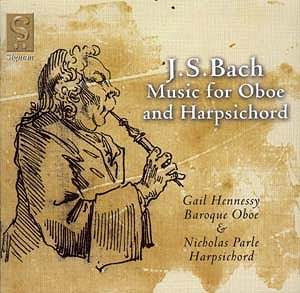
Johann Sebastian Bach (1685–1750)
Music for Oboe and Harpsichord
Gail Hennessy, oboe
Nicholas Parle, harpsichord
Recorded December 2000, St. Andrew’s Church, Toddington, Gloucestershire
Signum SIGCD034 [68:39]
Bach’s music for oboe and — well — harpsichord—that curious nexus where Baroque elegance meets instrumental idiosyncrasy—promises much but here delivers a complicated brew. This disc, led by Gail Hennessy and Nicholas Parle, gathers sonatas and related works, some originally conceived for flute or other instruments, arranged or adapted with varying degrees of persuasiveness.
The programme is ambitious: the G minor sonata BWV 1030b, probably intended for oboe but surviving only in flute score; the C major sonata BWV 103 with its solo oboe treatment; the ‘Organ’ trio sonata BWV 521; and others from the Well-Tempered Clavier—essentially a mixed bag of canonical and dubious Bach authorship. The very first thing to note is the album’s sonic imbalance. The oboe—Hennessy’s instrument—occupies the foreground with relentless insistence, its timbre often piercing, almost brash in the upper register.
This is no mellow reed; rather, it sometimes bites harshly, a thin edge; to the sound that grates when the music calls for warmth or lyricism. Against this, Parle’s harpsichord feels relegated to a shadowy background, its intricate figuration and crucial harmonic foundation frequently swallowed whole. This is a puzzling production choice, particularly given the trio sonata BWV 521, where the keyboard handles two of the three contrapuntal lines and ought to be assertively audible.
Instead, the harpsichord’s voice is muffled, creating a disconcerting imbalance that undermines the polyphonic clarity so vital to Bach’s chamber textures. Hennessy’s decision to perform the flute sonata BWV 103 alone — without continuo, is a gamble that partially pays off. The oboe’s plaintive “"Andante"” and nimble “"Presto"” dance with a certain intimacy in this stripped-down setting.
Yet the oboe’s natural limitations as a solo instrument—its relatively breath-constrained phrasing and less sustained tone compared to the flute—surface here. The music sometimes feels exposed, the absence of continuo leaving gaps where harmonic warmth and rhythmic propulsion falter. There’s an intriguing idea behind this approach, one that hints at Bach’s compositional intentions, but the execution falls short of convincing….
By contrast, the G minor sonata BWV 102’s movements brim with the characteristic Baroque tension and — well — release: the "Allegro" gestures sharply, the "Adagio" sighs with poignancy, and the final "Allegro" rushes with kinetic energy. Hennessy negotiates these shifts with a measure of stylistic understanding, though again the instrument’s tonal harshness intrudes on moments that call for tenderness. Parle’s harpsichord is more audible here, but the recording still leans heavily toward the oboe, robbing the dialogue between the two instruments of its full effect.
The leader’s presence feels palpable even in this studio setting.
The inclusion of the Prelude and Fugue in c minor BWV 871 from The Well-Tempered Clavier, Book II, is curious if not altogether successful. Extracted and — well — transcribed for harpsichord and oboe, the drastically different instrumental demands of these keyboard-centric pieces make the adaptation feel forced. The fugue’s dense contrapuntal voice-leading requires crystalline articulation and — well — balanced voicing—yet here it comes off somewhat cluttered, the oboe struggling to blend with the harpsichord’s keyboard texture rather than complement it.
What remains undeniable, however, is the underlying charm and inventiveness of these works themselves. Bach’s writing for oboe—when it is authentically his—is a subtle exercise in balancing pastoral lyricism with the expressive constraints of the instrument. The Siciliano movements, in particular, reveal a tender grace and serene melancholy that, when realised with more sympathetic tone and texture, can be transcendent.
The recording venue, St. Andrew’s Church, lends a somewhat dry acoustic, which doesn’t aid the oboe’s occasionally abrasive tone nor help the harpsichord’s quiet inner voices to bloom. One might have hoped for a more intimate space, or a recording that positioned instruments in more equitable sonic territory—especially since Signum’s; own earlier release of Bach’s viola da gamba sonatas showd, with Alison Crum and Laurence Cummings, a masterclass in balance and presence.
There, the harpsichord’s two voices were assertive without overpowering, the gamba singing out in a perfect, contrapuntal partnership. Here, sadly, the precedent is not followed. In sum, this disc offers a compelling but flawed encounter with Bach’s oboe and harpsichord repertoire.
Its programming is adventurous; its interpretative decisions—particularly the unaccompanied oboe sonata—thought-provoking; yet the uneven recording and tonal choices prevent it from fully realising the music’s potential. For those seeking a unique perspective or willing to navigate its rough edges, there is interest to be found. But for a definitive hearing of Bach’s chamber works with oboe, this will not suffice.
A valiant attempt, yes—but one that leaves the listener wishing for greater tonal — warmth, clearer instrumental dialogue, and an overall sound balance that respects Bach’s architectural clarity.