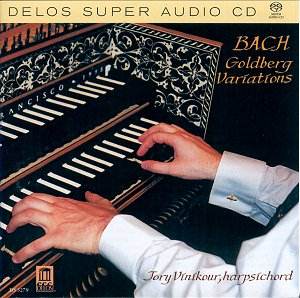
Johann Sebastian Bach: Goldberg Variations, BWV 988
Jory Vinikour, harpsichord
Recorded October 2000, Skywalker Sound, Marin County, California
Label: Delos DE 3279 [85:39] [2 CDs]
At first blush, anyone who ventures into the sprawling discography of the Goldberg Variations knows the terrain is treacherous: every nuance, every ornamentation, every tempo choice has been scrutinized, dissected, and—let’s be honest—overdone. Into this crowded field steps Jory Vinikour, an American harpsichordist still early in his recording career, but already exhibiting a keen and unmistakable voice. His second solo project, following a well-received 1999 release of Bach’s Toccatas, is a fine harpsichord set that intrigues as much by what it chooses to emphasize as by its sheer sonic clarity.
The instrument itself deserves immediate mention: a Kevin Fryer Ruckers copy modeled on the 1640s — harpsichord preserved in Colmar—a choice that sounds almost too scholarly but pays dividends in tonal color. The upper registers are sharp and incisive without shrieking, slicing through the texture with crystalline clarity. The bass, while perhaps a touch thin, retains sufficient body so the whole harpsichord doesn’t feel top-heavy or brittle.
And here’s a subtlety: the tuning—though not specified—carries a whiff of unequal temperament — lending certain dissonances a rough-hewn, almost palpable edge. It’s this very roughness that, paradoxically, colors the emotional landscape, particularly in Variation 25. Vinicour’s Goldbergs unfold over two discs, over 85 minutes—generous by any modern standard and — well — a blessing in itself.
No cuts, no forced accelerandos to squeeze everything under a time limit. This breathing room allows for a interpretation that is, at times, luxuriantly slow (the opening Aria clocks in at nearly five minutes, with the da capo extending beyond that) but never indulgent. His ornamentation—florid without flamboyance, recalling a Ton Koopman-like fluency—feels organic, the embellishments woven into the fabric rather than stitched on as decorative afterthoughts.
In Variation 7, for instance, the rapid passagework is leavened by subtle flourishes that sparkle but don’t clutter the line. There is remarkable sensitivity throughout the slower variations. Variation 9 is a study in restraint and nuance—phrasing shaped with a tender hand, subtle dynamic shading implied rather than overtly stated.
Then there’s Variation 11, where Vinikour’s phrasing breathes with a vocal-like quality, the ornaments serving as expressive punctuation marks rather than mere technical bravura. And Variation 13—a slow sarabande—is played with a lyrical intensity that holds the listener rapt without ever sounding precious. Contrast this with the French overture of Variation 16 at the start of the second — half: it bursts forth with a flamboyant energy, replete with vigorous articulation and rhythmic snap.
Vinikour makes the overture feel grand and ceremonious, yet personal rather than pompous. It’s a reminder that the Goldberg Variations are not a monolith but rather a kaleidoscope of styles and affects, all requiring different approaches—and here our harpsichordist shows commendable versatility. Variation 25 is the undisputed emotional fulcrum of this set.
The maestro’s presence feels palpable even in this studio setting.
At just under eleven minutes, it’s a performance that lingers—almost meditates—on the variation’s chromatic heart. Vinikour’s phrasing here is fluid — almost improvisatory, allowing the music’s structural drama to unfold naturally. The instrument’s tuning quirks become especially audible, lending a raw immediacy: those slightly off-center notes resonate, almost like a human sigh caught in sound.
One could argue this is one of the most affecting harpsichord renditions of this movement currently available. The album—engineered at Skywalker Sound—deserves a nod as well. The acoustic places the harpsichord in a close but not claustrophobic space, with no heavy-handed reverb to blur the articulation.
The sound is immediate, detailed, and engaging—qualities essential for a work where every trilled note, every mordent matters immensely. There are two versions available: the standard two-CD set priced modestly and a pricier SACD edition with dual-layer technology offering high-density DSD audio. Both provide the same program, but audiophiles might prefer the SACD’s extra clarity and dynamic range, especially on headphones or high-end systems.
In sum, Jory Vinikour’s Goldberg Variations stand out not by rewriting interpretive conventions but by inhabiting them with a fresh vitality and discernment. His playing balances scholarly respect with an almost conversational warmth—no small feat in such a canonical work. This is a young artist’s confident declaration: here is someone who understands Bach’s labyrinthine architecture yet isn’t afraid to let the music breathe, to pulse with life and surprise.
For those already familiar with the Goldbergs—and who isn’t?—this recording deserves serious attention. Vinikour’s energy, his well-judged ornamentation, and the sheer sonic beauty of the harpsichord — make this one of the more compelling harpsichord sets of the past decade. It is, in short, a notable addition to an all-too-familiar repertoire, illuminated by passion and — well — precision alike.