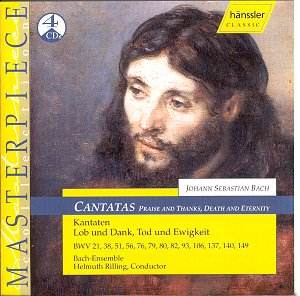
Bach Cantatas
Helmuth Rilling, Gächinger Kantorei Stuttgart, Bach-Collegium Stuttgart
Hänssler Classic 94028 (4 CDs)
Helmuth Rilling’s complete Bach cantata cycle, recorded between 1969 and 1984, stands as one of those monuments that forces us to reconsider what we mean when we speak of “authenticity” in reading. Here, gathered in this four-disc sampling, are thirteen cantatas that reveal both the considerable strengths and the occasional limitations of Rilling’s approach—an approach that now seems to belong to another era, though whether that’s cause for celebration or regret depends entirely on where you stand in the endless, exhausting debates about period practice.
Let me say at once: these performances give enormous pleasure. They’re also deeply unfashionable.
Rilling learned his Bach from Karl Richter, and it shows. The orchestral forces are substantial, the tempi broad (sometimes too broad), the sound rich and full-bodied in ways that make the period-instrument brigade reach for their smelling salts. The opening chorus of Ein feste Burg, BWV 80, arrives with all the weight of a Lutheran fortress—mighty, immovable, perhaps even a touch bombastic. Some will find it insufferably heavy. I found it thrilling, though I wouldn’t want every cantata approached this way. The question is whether Bach’s music can accommodate such amplitude, and the answer, surely, is yes. Bach is bigger than any single interpretive stance, thank God.
The real glory here lies in the solo singing. Arleen Auger’s BWV 51, Jauchzet Gott in allen Landen, is simply ravishing—light, pure, and stylish in ways that transcend questions of period practice. Her trills sparkle without affectation, her passagework dances with an ease that makes technical difficulty vanish. The final “Alleluja” ascends with such radiance that you forget to worry about whether she’s using too much vibrato. (She isn’t.) Rilling supports her with uncommon sensitivity, allowing the music to breathe, to expand and contract naturally rather than driving forward with metronomic rigidity.
Fischer-Dieskau’s contributions to BWV 56 and 82—the two great solo cantatas for bass—invite inevitable comparison with his earlier recordings for Archiv with Richter. These Hänssler versions don’t quite match those legendary performances, but they’re hardly disgraceful. If anything, they’re slightly more mannered, the interpretive gestures more pronounced. In “Ich habe genug,” the opening aria unfolds with almost excessive deliberation, every word weighted, every phrase shaped with such care that spontaneity occasionally suffers. Yet the voice remains glorious, the musicianship beyond reproach. And when the oboe enters with that ineffably sad melody—played here with real tenderness—you remember why this cantata has moved listeners for nearly three centuries.
The mixed-voice choirs present another point of contention. We now know—or think we know—that Bach used predominantly male voices in Leipzig, though the evidence remains maddeningly incomplete. Rilling opts for women on the soprano and alto lines, and the results are consistently musical, well-balanced, secure. The Gächinger Kantorei produces a warm, blended sound that some will find too smooth, lacking the edge and bite of smaller period ensembles. In the great chorale fantasia that opens BWV 76, Die Himmel erzählen die Ehre Gottes, the choral entries emerge with satisfying clarity, the counterpoint well-articulated despite the full forces. Whether this represents Bach’s sound-world is another question entirely—and possibly an unanswerable one.
Continuo realizations prove more problematic. The cello joins in almost everywhere, thickening textures that sometimes want transparency. The harpsichord and organ parts occasionally indulge in decorations that feel more 1970s than 1720s—arpeggiated chords that add little except a vague sense of busyness. In the more intimate moments, particularly the recitatives, this approach can muddy waters that should remain clear. Listen to the bass recitative in BWV 56, “Endlich, endlich wird mein Joch,” and you’ll hear what I mean: the cello line, sustained and prominent, competes with the voice rather than supporting it.
Rilling himself has described his role as synthesizer between historical and romantic approaches. It’s an honest self-assessment. His tempi tend toward the moderate—"Allegro"s that could press forward more urgently, slow movements that luxuriate perhaps too comfortably. Yet there’s wisdom in this restraint. The music breathes. Phrases shape themselves naturally. Singers can actually sing rather than gasp for air. In our rush to embrace ever-faster tempi, ever-smaller forces, ever-greater “authenticity,” we sometimes forget that music must be sung and played by human beings with lungs and fingers and fallible concentration.
The lesser-known soloists acquit themselves honorably. Adalbert Kraus brings a bright, focused tenor to his assignments; Philippe Huttenlocher’s bass sounds slightly grainy but musically intelligent. Helen Watts, that great English contralto, lends her distinctive timbre to several alto arias. The orchestral playing throughout maintains high standards—modern instruments, yes, but played with attention to articulation and dynamic shading. The wind obbligati deserve special mention: oboes that sing with real character, a trumpet in BWV 51 that negotiates Bach’s fiendish writing with impressive security.
BWV 21, Ich hatte viel Bekümmernis, that immense cantata of spiritual struggle and consolation, receives a performance of considerable power. The opening Sinfonia emerges dark and brooding; the great choral fugue “Was betrübst du dich, meine Seele” builds with genuine cumulative force. If the final “Sei nun wieder zufrieden” sounds a touch too comfortable—the consolation coming perhaps too easily—well, that’s a risk inherent in Rilling’s approach. Suffering in these performances never feels quite raw enough, joy never quite ecstatic enough. Everything exists in a civilized, slightly subdued emotional register.
Documentation presents a real problem. The booklet is skeletal—barely adequate for those who already know these works intimately, utterly insufficient for anyone coming to them fresh. Hänssler directs us to their website for complete texts and translations, a cost-saving measure that may prove penny-wise and pound-foolish. Budget