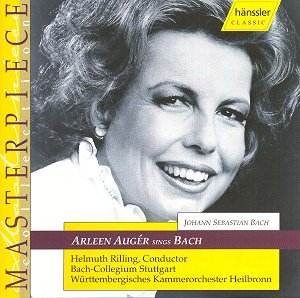
BACH Cantata Arias Arleen Augér, soprano Bach-Collegium Stuttgart, Württembergisches Kammerorchester Heilbronn / Helmut Rilling HÄNSSLER; CD 94.035 [67:20] — The voice arrives like light through a cathedral window—clear, warm, unforced. And then you realize: this is what Bach singing ought to be. Arleen Augér died in 1993, far too young at fifty-three, robbing us of one of the most naturally musical soprano voices of the late twentieth century.
This anthology, drawn from Helmut Rilling’s complete cantata cycle for Hänssler, preserves thirteen arias that prove why her absence still registers as a particular loss for those of us who care about Bach realization. Not the flashiest singer — certainly. Not the most extroverted.
But listen to how she shapes the long-breathed phrases of “Bete aber auch dabei” from BWV 115—there’s an inevitability; to her phrasing, as if the music were simply passing through her rather than being imposed by interpretive will. The California-born soprano brought to Bach an unusual combination of technical security and spiritual transparency. Her coloratura never calls attention to itself (though it’s immaculately placed), and her vibrato—always a contentious matter in Bach singing—hovers at that ideal point where it adds warmth without obscuring line.
In “Mein gläubiges Herze” from BWV 68, that most familiar of cantata arias, she avoids the cuteness that can afflict the piece. The sixteenth-note runs bloom naturally from the vocal line; you hear joy — not display. But it’s in the more dramatically charged arias that Augér reveals her full range.
“Tief gebückt und voller Reue” from the solo cantata BWV 199 finds her negotiating Bach’s most demanding coloratura with an intensity that never sacrifices musical shape to emotional urgency. The aria spans an enormous range—both vocal and expressive—and she meets its challenges with what sounds like ease, though one knows better. The long melismas on “Reue” (repentance) cascade downward with a weight that feels almost physical.
Even finer is “Wie zittern und wanken” from BWV 105. Here the obbligato oboe weaves around the vocal line in one of Bach’s most exquisite dialogues,; and Augér matches her unnamed wind colleague (Rilling’s documentation was never his strong suit) with uncanny sensitivity. The two lines intertwine, separate, echo—and she modulates her tone to reflect each shift in the relationship.
When the oboe ascends, she darkens slightly; when it descends into her register, she thins her sound to let it through. This is chamber music at the highest level. The dramatic recitatives and — well — arias from BWV 57 and BWV 199 reveal yet another dimension.
“Ich wünschte mir den Tod” carries the weight of genuine despair—not operatic breast-beating, but something more inward and therefore more devastating. Augér’s control of dynamics here is extraordinary; she can float a pianissimo that still projects, then swell to full voice without any sense of gear-shifting. The aria demands a singer who can sustain long phrases while navigating treacherous leaps, and she does so with a security that allows her to focus on meaning rather than mere survival.
Rilling’s accompaniments, as always in this cycle, are solid if not particularly imaginative. The Stuttgart forces play with professional competence, though one occasionally wishes for more air in the string sound, more transparency in the continuo realization. The recorded sound from 1983 holds up reasonably well—a bit close-miked for my taste, but clear and well-balanced.
You hear everything, perhaps too much: the intake of breath before “Komm in mein Herzenshaus” from BWV 80, the slight catch in the voice during one of the long phrases in “Die Seele ruht in Jesu Händen” from BWV 127. These are human imperfections, and they don’t trouble me. Better this than the antiseptic perfection of digital editing.
The aria selection itself is judicious, favoring the lyric and devotional over the virtuosic for its own sake. One might quibble with individual choices—I’d have traded “Meinem Hirten bleib ich treu” from BWV 92 for almost any aria from BWV 51, for instance—but the disc hangs together as a coherent recital. Each aria illuminates a different facet of Bach’s inexhaustible invention in writing for; the soprano voice, and — well — Augér meets each challenge with what seems like natural aptitude.
(We know better, of course. This kind of naturalness is the product of profound technical mastery and deep musical intelligence.)
What strikes me most, returning to this disc after many years, is how little Augér’s approach has dated. The period-instrument revolution has given us faster tempos, smaller forces, different notions of phrasing and articulation.
Yet her singing transcends questions of style. The voice itself remains refined—focused, even throughout its range, capable of both brilliance and tenderness. And her musicianship, her ability to make Bach’s endlessly inventive lines sound both spontaneous and inevitable, belongs to no particular era or school.
At budget price, this is essential. For Bach lovers, for voice fanciers, for anyone who wants to hear what honest, unaffected, deeply musical singing sounds like. We won’t hear her like again.