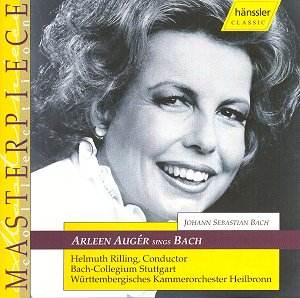
BACH: Cantata Arias
Arleen Augér, soprano; Bach-Collegium Stuttgart / Helmut Rilling; Württembergisches Kammerorchester Heilbronn
Hänssler CD 94.035 [67:20]
This anthology arrived too late—or perhaps exactly when needed. Arleen Augér died in 1993, her career cut short at fifty-four. By then she’d sung everything from Mozart to Strauss, from lieder recitals to the great oratorios, always with that peculiar combination of technical security and spiritual transparency that made her irreplaceable. This disc, drawn from Helmut Rilling’s sprawling cantata cycle for Hänssler, catches her in music where she had no equals.
I’ve been listening to Bach sopranos for forty years. The problem is always the same: too much voice overwhelms the line, too little can’t sustain it. Augér solved this by not solving it—by simply singing what Bach wrote, following the musical argument wherever it led without imposing personality or “interpretation” on top of it. The coloratura in “Mein gläubiges Herze” (BWV 68) dances because the notes dance, not because someone decided it should sound joyful.
Listen to “Bete aber auch dabei” from BWV 115. The tempo is moderate, the melodic line long-breathed and contemplative. Augér’s voice floats above the continuo with that slightly covered quality she used in slow movements—not quite straight tone, not quite vibrato, but something in between that gives the phrases both focus and warmth. She never pushes. The aria unfolds like a meditation, which is precisely what it is.
But she could push when the music demanded it. “Tief gebückt und voller Reue” (BWV 199) requires vocal heft—those leaping intervals, that insistent rhythmic drive. Augér had reserves of power she rarely displayed in Mozart, and here they serve the penitential fervor of the text. The voice darkens, the attacks sharpen. This is soprano singing of real dramatic weight.
The high point—and there are several—comes in “Wie zittern und wanken” from BWV 105. The obbligato oboe weaves around the vocal line in one of Bach’s most intricate dialogues, and Augér matches the instrumentalist phrase for phrase. Not literally, of course. But the musical thinking is identical: the same sensitivity to harmonic inflection, the same understanding of where phrases begin and end. When voice and oboe converge on cadences, you hear two musicians speaking the same language.
“Ich wünschte mir den Tod” (BWV 57) goes deeper still. This is one of Bach’s most emotionally raw arias—the text speaks of longing for death, and the music doesn’t soften the sentiment. Augér gives it everything: the desperate leaps upward, the chromatic descents, the moments where the voice simply hangs suspended over diminished harmonies. It’s almost operatic in intensity, yet never loses its devotional character. How she managed that balance I’m not sure.
Rilling’s accompaniments are what they always were in this project—solid, well-prepared, occasionally a bit foursquare. The Württemberg Chamber Orchestra plays with more flexibility than the Bach Collegium, though both ensembles serve the music honorably. One wishes for more varied continuo realization in some arias, but that’s quibbling.
The program runs over an hour, thirteen arias without much attention to key relationships or dramatic arc. It doesn’t matter. Each aria stands as its own small universe, and Augér inhabits each one completely. “Die Seele ruht in Jesu Händen” (BWV 127) offers the kind of radiant simplicity that was her signature—no fuss, no mannerisms, just pure singing. “Auch mit gedämpften, schwachen Stimmen” (BWV 36) shows her skill with ornamentation, adding tasteful appoggiaturas without disturbing Bach’s architectural clarity.
The sound is warm, close-miked but not oppressively so. You can hear Augér’s breath control, the way she shapes vowels to maintain line. These are details that matter in Bach.
I keep returning to a single quality: her humility before the music. That sounds pious, maybe sentimental. But it’s the only word that fits. Augér never sang Bach as if she were doing it a favor. She served the music, and in serving it completely, she revealed depths that more overtly expressive singers miss.
This disc belongs in any serious Bach collection. At bargain price it’s essential. We won’t hear this kind of singing again—not because mastery has declined, but because the spiritual and musical qualities Augér brought to these arias don’t often appear in the same voice. A precious document.