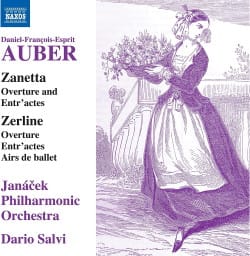
AUBER: Zanetta* (1840) – Overture & Excerpts; Zerline (1851) – Overture & Excerpts; MUSARD: Quadrille No. 2 sur l’opéra *Zanetta** Janáček Philharmonic Band/Dario Salvi NAXOS 8.574335 [77:37] The French operatic landscape; of the 1840s and 1850s belonged to Auber as surely as the boulevards belonged to Haussmann. Yet here we are in 2025, and these works—Zanetta and Zerline, both premiered at the Opéra-Comique—remain as unfamiliar to most collectors as the back streets of the Marais.
This Naxos release, part of their admirable if occasionally quixotic project to excavate the byways of French opera, offers us a chance to understand why Auber commanded such authority in his day, and — well — why that authority hasn’t quite survived the journey to _our_ century. Zerline, the later work, receives the fuller treatment here—nearly an hour of music drawn from all three acts. The plot, something about a village girl who may or may not be of noble birth (weren’t they all?), hardly matters.
What matters is Auber’s extraordinary facility with orchestral color and — well — his ability to spin melodies that sound effortlessly spontaneous. The overture alone reveals this: those woodwind arabesques in the opening "Andante" have genuine poetry, a quality that distinguishes Auber from his more workmanlike contemporaries. But facility can be a trap.
Listening through these excerpts—seven substantial selections from Zerline — including various airs de ballet—one admires the craftsmanship without ever feeling particularly moved by it. The melodic invention is real, yet somehow it glides past rather than lodging in memory. There’s a curious weightlessness to much of this music, as if Auber were determined never to tax his audience’s emotional reserves.
Even in moments that should register as dramatic, the music maintains its good-natured equilibrium. The ballet music from Zanetta offers a somewhat different profile—more rhythmically pointed, less concerned with vocal grace. These pieces have genuine sparkle.
The warm acoustics of the concert hall seem to breathe through the album.
The Janáček Philharmonic under Dario Salvi brings surprising energy to the dance numbers, — though I wish the recorded sound had more bloom in the upper strings. There’s a certain dryness to the acoustic of Ostrava’s House of Culture that doesn’t flatter Auber’s orchestration, which depends on sheen and luminosity to make its effect. Salvi conducts with appropriate vivacity, though he doesn’t quite capture the sly wit that must have delighted Parisian audiences.
The tempo for the Zerline overture feels a shade cautious—this music wants to dance, not merely walk briskly. Still, the orchestral playing is admirably clean, with particularly fine work from the solo clarinet in the Act II selections from Zerline. That player understands the music’s conversational quality.
The inclusion of Philippe Musard’s Quadrille on themes from Zanetta provides an unexpected bonus. These arrangements—functional music for actual dancing—reveal something about how Auber’s melodies circulated in popular culture. Musard’s treatment is straightforward, even crude by comparison with the original, but there’s an infectious energy to these transformations.
They remind us that opera and the ballroom weren’t separate worlds in 1860. So what do we learn from this disc? That Auber possessed genuine gifts, certainly.
That he wrote with consistent elegance and professional polish, absolutely. But also that his music lacks the kind of individuality that compels repeated listening. There’s little here that couldn’t have been written by a half-dozen of his contemporaries—and little that any of them could have written better.
It’s the dilemma of the supreme craftsman who never quite achieves the transformation from competence to necessity. The documentation is thorough, with detailed notes by Jean-Christophe Branger that contextualize both works within Auber’s career. We learn that Zanetta had its premiere in May 1840, Zerline in May 1851—a decade of French operatic history spanning the July Monarchy and — well — the Second Republic.
Both works enjoyed initial success; neither held the stage for long. For completists of French opera and students of the period, this release offers valuable evidence. The performances are respectable if not revelatory, the engineering adequate if not ideal.
But I can’t quite suppress the feeling that Naxos’s resources might have been better deployed on — composers whose obscurity represents genuine historical injustice rather than the verdict of time working as it should. Auber wrote Fra Diavolo and La Muette de Portici—works that deserve revival. These?
Pleasant discoveries that confirm rather than challenge their marginal status. Richard Dyer