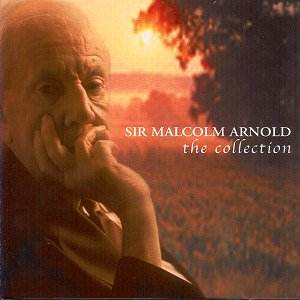
ARNOLD: The Collection
Royal Philharmonic Orchestra/Vernon Handley; London Musici/Mark Stephenson; Grimethorpe Colliery UK Coal Band/Elgar Howarth; Julian Bream, guitar; David Nettle & Richard Markham, pianos
RCA-BMG 74321 88392–2 [2CDs: 75.36, 76.04]
The title is a problem from the start. “The Collection” promises wide-rangingness—suggests, really, that this two-disc set might serve as your Arnold primer, your definitive introduction to a composer who deserves far better than he’s received from the musical establishment. But where are the symphonies? Where’s the chamber music that shows Arnold at his most unguarded, his most searching? The film scores that paid the bills and produced some genuinely inspired writing?
What we have instead is Arnold in his public-facing mode: entertaining, skillful, never less than professionally accomplished. And there’s real value here, make no mistake. Vernon Handley—who understood this composer’s idiom as well as anyone—leads the Royal Philharmonic through overtures that crackle with theatrical energy. The Anniversary Overture has genuine swagger, and Beckus the Dandipratt (that wonderfully improbable title) receives a performance of wit and clarity. But the Grand, Grand Overture, written for Gerard Hoffnung’s concerts and requiring floor polishers, rifles, and vacuum cleaners, loses something essential on disc. You need to see the visual joke. The absurdist humor doesn’t quite translate when you’re sitting in your listening room.
The real treasure here dates from 1959. Julian Bream’s album of the Guitar Concerto remains, more than six decades on, a benchmark performance. The Melos Ensemble plays with chamber-music intimacy under Arnold’s own direction, and Bream shapes the melodic lines with that particular combination of poetry and rhythmic precision that marked his best work. Listen to how he handles the lyrical second movement—the phrasing breathes naturally, never sentimental but deeply felt. The recorded sound has held up remarkably well, too, with the guitar placed just forward enough in the perspective without dominating the texture.
David Nettle and Richard Markham tackle the Concerto for Two Pianos (3 Hands)—one of those commissions that arose from a specific circumstance (one pianist had lost the use of an arm) and that Arnold fulfilled with characteristic professionalism and ingenuity. The "finale" is genuinely funny, a romp that never condescends to its unusual premise. The pianists negotiate the technical challenges with aplomb, though I found myself wishing for slightly more tonal variety in the quieter passages.
Mark Stephenson and London Musici contribute the Serenade and Larch Trees, Arnold’s Opus 3. The Serenade receives a performance of considerable charm—the string tone warm without being soupy, the phrasing shapely. These players understand that Arnold’s apparent simplicity requires careful attention to balance and color. In the Larch Trees, written when Arnold was barely out of his teens, you can already hear that gift for melody, that almost Ravelian sense of instrumental color.
But then we come to the brass band material, which occupies far too much space across these two discs. Now, I have nothing against brass bands—the Grimethorpe Colliery UK Coal Band under Elgar Howarth plays with tremendous discipline and tonal refinement. And Arnold wrote idiomatically for the medium in his two Little Suites, the Fantasy for Brass Band, and The Padstow Lifeboat. These pieces show the composer’s understanding of brass sonority, his ability to write music that sits well under the fingers.
The problem is the arrangements. Eric Farr has transcribed the English, Scottish, and Cornish Dances for brass band, and while he’s done a competent job, these are Arnold’s arrangements we’re hearing, not Arnold’s originals. The orchestral versions—with their varied timbres, their subtle shifts of color—are simply superior. Why include these transcriptions when the authentic versions exist? It’s rather like serving a photocopy when you have access to the painting itself.
The Grimethorpe players do what they can. The Scottish Dances have genuine verve, and Howarth knows how to pace these pieces, how to build to climaxes without rushing. But the brass band sound, for all its power and brilliance, becomes monochromatic over the course of an hour. You start longing for a woodwind choir, for string sonority, for the play of different instrumental families that makes the orchestral versions so appealing.
There’s a fundamental miscalculation at work here. This set commemorates Arnold’s eightieth birthday, but it presents only one facet of a complex artistic personality. The darker Arnold—the composer of those extraordinary symphonies, works that grapple with genuine emotional turmoil—is nowhere to be found. We get the entertainer, the craftsman, the supplier of light music for various occasions. All of which Arnold did brilliantly, but it’s not the whole story. Not by a considerable distance.
The recorded sound varies, naturally enough, given that these performances span nearly four decades. The Bream recording shows its age only slightly, with a touch of tape hiss that never intrudes. The more recent material sounds superb—clear, well-balanced, with plenty of presence. The brass band recordings are particularly vivid, capturing the ensemble’s characteristic blend without the brittleness that sometimes mars recordings of this medium.
So what are we left with? A collection that offers genuine pleasures—that Bream reading alone justifies the price of admission—but that ultimately fails to represent Malcolm Arnold’s achievement with any real wide-rangingness. It’s rather as if you assembled a Britten retrospective consisting entirely of his lighter occasional pieces while ignoring the operas, the War Requiem, the late chamber works. You’d have some attractive music, certainly, but you’d be missing the essence of the man.
For listeners already familiar with Arnold’s symphonies and major works, this set provides some agreeable supplements. For newcomers, it offers a misleading portrait of a composer whose range and depth extended far beyond what’s represented here. The title promises more than the contents deliver—a pity, because Arnold deserved better as he entered his ninth decade.
Terry Barfoot’s assessment gets it about right: “good but might have been better still.” I’d put it more bluntly: inadequate as “The Collection,” valuable as a miscellany.