Sir Arnold Bax
String Quartet No. 1 in G major (1918)
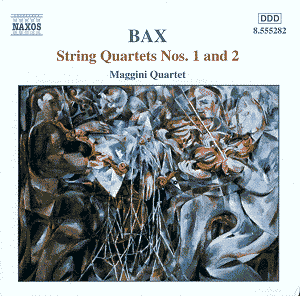
String Quartet No. 2 in A minor (1925) Maggini String Quartet Recorded 19–21 December 1999, Potton Hall, Suffolk NAXOS 8.555282 [54:00] Sir Arnold Bax’s reputation has long; hovered in the semi-shadows of English music — a figure admired mostly for his orchestral canvases, those lush, sometimes overwrought symphonies and tone poems.
Yet here, in these two string quartets — recorded by the Maggini String Quartet, an ensemble already respected for its finesse with British repertoire — we glimpse a more intimate, perhaps less indulgent Bax. The chamber works don’t flaunt themselves with orchestral grandeur but instead explore a quieter, more concentrated lyricism. The first Quartet in G major, dating from 1918, unfolds over three movements in a compact 24-minute span.
It’s a work that wears its late-Romantic heart on its sleeve but with an economy that surprises. The opening "Allegro", while richly tinted with Bax’s characteristic harmonies, avoids the trap of excessive floridity. There is a certain muscularity to the writing here — the first violin line sometimes soaring, sometimes tender, darting through modal shifts that hint at Bax’s Celtic inflections.
The ensemble’s tone is warm, almost velvety, with a touch of bloom on the upper strings and a reassuring solidity in the cello’s lower register. You can almost sense the damp chill of an English autumn as the music’s more reflective episodes unfold. The second Quartet in A minor (1925) presents a more complex architecture, stretching closer to thirty minutes.
Here Bax seems to be wrestling more overtly with formal ambition and emotional depth. The central slow movement, marked Molto espressivo, is perhaps the album’s most contentious feature — ten minutes long, it lingers, arguably too long for its own dramatic weight. But there is undeniable fascination in Bax’s treatment of sonority: the way the ensemble weaves dissonant threads with near-Impressionistic subtlety, creating a funeral-like atmosphere that feels both mournful and ritualistic.
The warm acoustics of the concert hall seem to breathe through the recording.
The Maggini’s control of rubato and dynamic shading in this movement is exemplary, their attention to phrasing so meticulous that even the longest notes seem charged with a kind of quiet desperation. The "finale" jolts us back to life — lively, almost sardonic at times. Its "scherzo"-like character contains a funeral episode that stands out starkly, a moment of solemnity nestled inside a generally vivacious movement.
This kind of juxtaposition is a hallmark of Bax’s chamber style: the constant; tension between light and shadow, serenity and agitation, the personal and the mythic. The Maggini players articulate these contrasts with impressive clarity, maintaining rhythmic precision even as the music’s texture thickens and unravels. One must mention the production itself — a somewhat modest Naxos budget affair, yet captured with admirable clarity and an atmospheric resonance that allows the music’s subtleties to breathe.
The hall’s acoustics contribute a natural reverb that enhances the string timbres without smearing detail. The balance between the instruments is well judged, and there’s a tangible sense of the musicians inhabiting the score, not merely executing notes. For those predisposed to view Bax as a composer of expansive orchestral soundscapes, these quartets; may come as a revelation: smaller in scale, certainly, but not diminished in expressive power.
They reveal a composer at once rooted in late Romantic idioms and quietly pushing towards the modern — seeking new colors and emotional nuances within traditional forms. In sum, this recording invites reappraisal of Bax’s chamber music — works that deserve a more frequent — hearing, not least because they offer a concentrated glimpse of his compositional personality, free from orchestral excess. The Maggini String Quartet’s commitment and sensitivity here make this Naxos disc a vital contribution — affordable, engaging, and rich with subtle rewards.