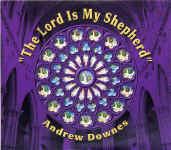
Andrew Downes
The Lord is My Shepherd and Other Sacred Choral Music
Royal Holloway Chapel Choir, Lionel Pike (director), Brian Moles (organ)
Recorded January 2001, Arundel Cathedral
Classicprint CPVPO14CD
Virgin Classics (distribution)
That particular brightness of period instruments catches the ear.
Utility music, yes—but not without its moments. Andrew Downes’s The Lord is My Shepherd and accompanying sacred works offer a collection that feels, at times, like a gentle meditation rather than a stirring concertante statement. This is largely music designed for the Anglican Evensong service, and as such its primary purpose is functional.
Yet, even within these unadorned textures, there are glimpses of something more — if you listen closely enough. The overall sonic palette is subdued: the choir’s unison passages, often slow-moving and harmonically unadventurous, ask for patience. Gregorian chant’s shadow looms large here, no surprise given Downes’s evident affinity for modal inflections and chant-like melodic contours.
One suspects, too, an influence from what the liner notes rather enigmatically call ‘heathen incantations,’ a phrase that evokes a certain primal austerity but which rarely translates into palpable tension or release in this setting. The result is a sound world that can feel static, bordering on the soporific if taken in one sitting. Take the psalm setting proper, “The Lord is My Shepherd” (Psalm 23).
It is unaccompanied and marked by a quiet confidence; yet, it does not quite lift the spirit as the text might demand. The phrase ‘I will fear no evil’ is tenderly wrought, a small jewel of expressive phrase-shaping amid the otherwise restrained lines. The choir’s blend here is pleasing — female sopranos and altos adding a silken sheen that helps to keep the texture from becoming too opaque or dull — but Downes’s harmonic language remains modest, sometimes too much so.
Contrast this with “I was Glad,” which breaks into brighter territory. Here, the text’s inherent joyfulness is caught in fleeting bursts of energy, particularly on ‘For my brethren and companions’ sake.’; These moments, while brief, suggest that Downes’s skill in text setting is more assured when the words themselves carry a buoyancy. Yet even these sections feel hemmed in by a certain plainness, a deliberate restraint that may not suit all tastes.
The Evensong responses, the Preces, and Psalm 121 are, predictably, serviceable rather than revelatory. The plainness of these settings seems intentional — a nod to the liturgical function of the music rather than to the concert hall. That said, the Magnificat emerges as the disc’s highlight.
Its organ accompaniment introduces welcomed tonal color and a series of dynamic climaxes that momentarily lift the music from its otherwise muted soundscape. The opening staccato vocal line, however, felt oddly at odds with my traditional image of the Virgin Mary: less innocence and wonder, more clipped urgency. Still, the movement carries a compelling forward momentum, giving the listener a hint of emotional complexity not often found elsewhere on the disc.
Then there is the Nunc Dimittis, composed during the composer’s bereavement — a work dedicated to his late mother. The poignancy of this fact lends a certain gravity to the piece, although the music itself remains understated. The recording venue, Arundel Cathedral, with its resonant but warm acoustic and splendid organ, provides a fittingly reverberant backdrop, allowing the choir’s voices to flower modestly without undue blur.
Brian Moles’s organ playing is sensitively measured, nuanced rather than grandiose, matching the choir’s contemplative mood. The Royal Holloway Chapel Choir, under Lionel Pike’s direction, benefits from clear diction and a supple, if restrained, ensemble sound. There is a certain uniformity to their tone that suits Downes’s evensong idiom well—this is not a choir chasing orchestral grandeur but rather one embodying devotional clarity.
The release quality is generally good, capturing the cathedral’s natural reverberation without drowning the choir or obscuring details. For those seeking a deeper acquaintance with Downes’s oeuvre, this disc is not the ideal starting point. The earlier reviewed Centenary Fire Dances offers a far more dynamic and vividly orchestrated introduction to his voice.
His Symphony No. 2, still awaiting a wide recording, remains a high priority for admirers of British symphonic music in the late 20th century. Additionally, forthcoming recordings of his flute and piano works with Andy Anson and Alan Cuckston are; eagerly anticipated and may reveal a more intimate, less liturgically bound side of his compositional personality.
In sum: The Lord is My Shepherd is a modest, dignified contribution to the Anglican choral repertoire. It may not thrill or surprise, but its sincerity and moments of genuine; beauty—especially in the Magnificat and certain psalm settings—offer a quiet, reflective listening experience. Listeners attuned to the nuances of service music and — well — the particularities of Downes’s harmonic language will find much to appreciate, while others might find themselves reaching for something with a touch more fire and invention.
David Wright’s liner notes, connecting the Nunc Dimittis to personal loss, add a human dimension often absent from purely technical assessments—and perhaps it is here, in the intersection of music, memory, and ritual, that the true essence of this disc lies. A thoughtful, if cautious, recommendation for enthusiasts of contemporary sacred music—just don’t expect to be carried away.