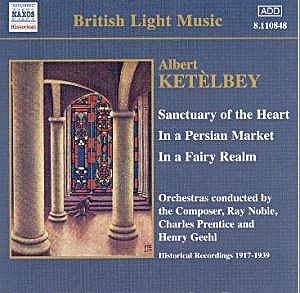
Albert Ketèlbey (1875–1959) Historic Recordings Vol 2 [JW] Label: Naxos Historical 8.110848 Duration: 61’42” Recording dates: London, 1917–1939 Performers: Various orchestras and choruses conducted by Albert Ketèlbey, Ray Noble, Charles Prentice, Henry Geehl; soloists Peter Dawson (bass-baritone), Florence Smithson (soprano), Dennis Noble; (baritone), Nellie Walker (contralto), Robert Easton and Oscar Natzke (basses), Albert Sandler (violin), Albert Ketèlbey (piano) — Albert Ketèlbey’s oeuvre is a peculiar, fascinating creature—half Victorian sentimentalist, half jazzy, bustling music hall impresario, wrapped in the garb of a self-styled imperial exotica conjurer. This Historic Recordings Vol 2 offers a richly varied snapshot of his interwar output, with performances spanning the somewhat crackly but charming 78rpm era into the cusp of modern recording. These are not just archival curiosities; they resonate with a curious vitality that still manages to surprise.
Take, for instance, “The Sacred Hour,” sung by Peter Dawson, whose bass-baritone rings out with devotional ardour, almost uncomfortably earnest but never less than compelling. Dawson’s voice fills the acoustic space with a warmth that’s tactile—one can almost smell the incense wafting from the imagined sanctuary Ketèlbey conjures. The orchestral underpinnings, though modest by modern standards, lay a solid foundation for Dawson’s pious declamation, the strings swaying gently like prayer ribbons caught in a chapel breeze.
Then there is Florence Smithson’s soprano in “In a Fairy Realm,” where her agile, strikingly clear coloratura transports one to a shimmering otherworld. She carves through Ketèlbey’s florid vocal lines with a deftness that belies the somewhat dated waltz rhythms beneath. This piece, rather charmingly pastoral, evokes a subtle mix of Dvořák’s Slavic lyricism and Tchaikovsky’s ballet suites, though Ketèlbey’s orchestration occasionally leans toward over-rich textures—tubular bells and all—blurred slightly by the limitations of early release but still quite evocative.
The “Algerian Scene,” featuring Albert Sandler’s violin with Ketèlbey himself at the piano, is a highlight for the connoisseur of early 20th-century exoticism. Sandler’s tone is reedy, slightly nasal but with a certain rueful sweetness that suits the East-meets-West conceit of the piece. This track is a reminder of Ketèlbey’s multi-instrumentalist background and the way his own hands shaped the music intimately, lending it a kind of authentic theatrical flair.
The piano accompaniment is light, delicately articulated—rococo yet infused with an undercurrent of vernacular dance rhythms. One cannot discuss Ketèlbey without the obligatory nod to In a Persian Market, his most famous number, here presented with all its loud, brash, and frankly absurd charm intact. Described at the time as an “educational novelty,” it now sounds like a madcap pastiche; of Orientalist clichés—calliopes, street vendors, snake charmers, all conjured through jaunty motifs and insistent rhythms.
It’s impossible not to smile at the garish orchestral colours—the clarinet’s slithers, the; exotic percussion effects—though, admittedly, the sheer kitsch can sometimes border on the cloying. Yet, the vivid orchestral energy and narrative drive make it endlessly entertaining. Vocally, the album offers a range of peculiar delights.
Dennis Noble’s baritone in “In the Mystic Land of Egypt” adopts the era’s stereotypical “Eastern” affectations with gusto, stepping forward to the mike (as the notes observe) to deliver vocal effects that range from the charmingly theatrical to the downright corny. Nellie Walker’s contralto provides a warm counterbalance in more reflective moments, though Robert Easton’s bass verges on the eccentric—with a voice one might compare, rather unflatteringly, to a distressed nanny goat, yet somehow imbued with a certain melancholic dignity. The sleeve notes’ reference to Sanctuary of the Heart—a fusion of English melodic themes with the Kol Nidrei chant, reflecting Ketèlbey’s personal life—is a fascinating insight.
One hears this act of musical embrace as a kind of slow, heartfelt dialogue between cultures; the thematic melding is subtle and touching but, to be honest, sometimes the transitions feel a little heavy-handed, the orchestration leaning towards the overblown. Still, the sincerity of the gesture shines through. Of particular interest are the earliest recordings, like “Fairy Butterfly” and “King Cupid” from 1917.
Though the surface noise is noticeable, the performances reveal Ketèlbey’s facility in vocal writing and his theatrical instincts—he might well — have pursued a more orthodox stage career, had he not found his niche in light music and silent film accompaniment. The recording quality, inevitably variable—some worn takes and — well — a touch of surface crackle—adds an immediacy and charm. It’s like overhearing a conversation across time, the ambient acoustics and — well — occasional mechanical hisses serving; as a reminder that these are voices and instruments captured in an era of nascent technology.
All told — this volume is a must-listen for those intrigued by the British light music tradition and the peculiar blend of high Victorian nostalgia and early 20th-century modernity that Ketèlbey embodies. His music may never have reached the serious concert repertoire, but it remains a potent document of its time—at once sentimental, theatrical, and, yes, often downright hilarious. Enthusiastically recommended for those willing to embrace its eccentricities without prejudice.