Alfred Brendel (piano)Academy of St Martin in the Fields, Neville Marriner
Decca · 4425712 · 2 hours 34 minutes
Mozart’s piano concertos occupy this strange, miraculous middle ground where everything sounds effortless and yet the emotional depth keeps catching you off guard — and Brendel understands that paradox better than almost anyone. His touch here is wonderfully conversational, like he’s thinking through each phrase in real time rather than delivering a polished lecture, and Marriner’s Academy keeps pace with that same lightness and wit. The slow movements in particular have a kind of aching tenderness that feels completely unforced, which is exactly what this music asks for.
Awards:
- Gramophone Awards — 1977 — Winner – Concerto
Alfred Brendel (piano)Academy of St Martin in the Fields, Neville Marriner
Decca · 4422692 · 2 hours 38 minutes
Mozart’s piano concertos occupy this strange, luminous middle ground where the soloist and orchestra feel less like two forces in dialogue and more like one breathing thing — and Brendel with Marriner captures that quality with uncanny naturalness. The playing is lean and clear-eyed without ever turning cool, which is exactly what these concertos need to keep their emotional honesty intact. If you’re building a Mozart concerto collection from scratch, this is a genuinely wonderful place to start.
Awards:
- Building a Library — March 2013 — CD Choice
- Penguin Guide — Rosette
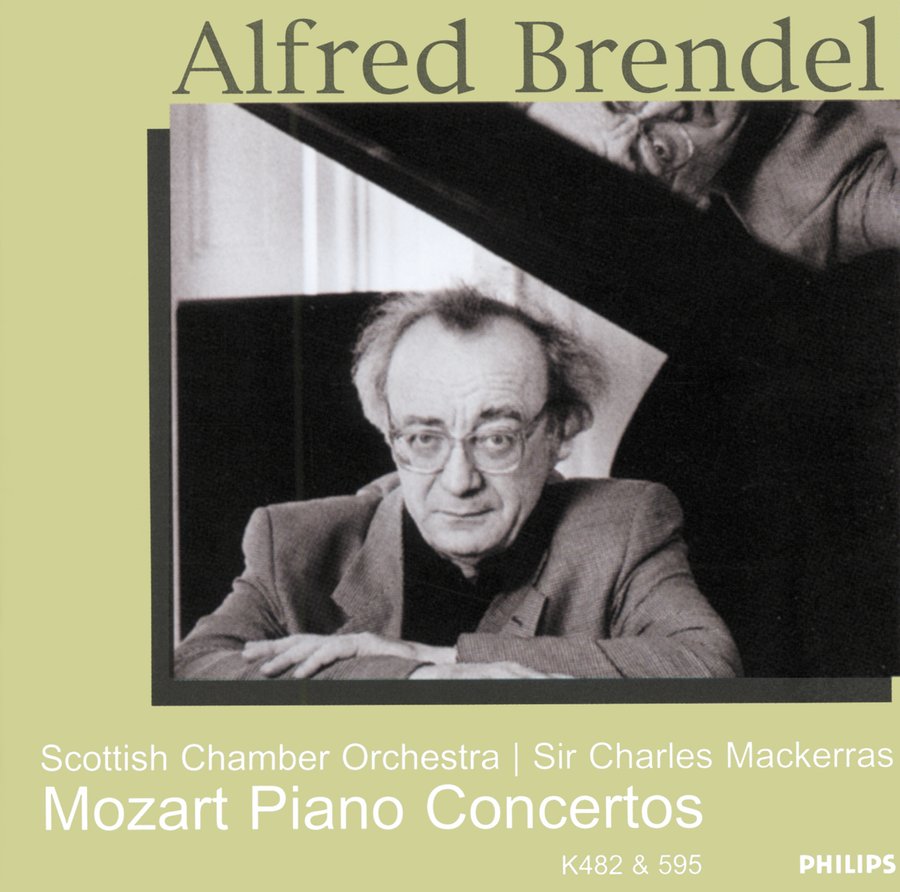
Alfred Brendel (piano)Scottish Chamber Orchestra, Sir Charles Mackerras
Philips · 4683672 · 67 minutes
There’s something almost conversational about the way Mozart writes for piano and orchestra in these two concertos — the soloist and ensemble feel like old friends finishing each other’s sentences, and Brendel and Mackerras understand that dynamic completely. Brendel’s touch in the slow movement of No. 27 is extraordinarily tender without ever tipping into sentimentality, finding exactly the kind of bittersweet clarity that makes late Mozart so moving. The Scottish Chamber Orchestra keeps things lean and transparent, which means every harmonic surprise lands with the impact Mozart intended.
Awards:
- Building a Library — May 2002 — First Choice
Alfred Brendel (piano)Academy of St. Martin in the Fields, Sir Neville Marriner
Philips · 4757337 · 3 hours 2 minutes
Mozart’s piano concertos have this rare quality where wit and aching tenderness can exist in the same phrase, and Brendel understands that completely — he never lets the playfulness tip into mere charm or the slow movements become self-indulgent. Marriner and the Academy of St. Martin in the Fields keep the orchestral textures lean and conversational, so the dialogue between piano and ensemble feels genuinely alive rather than accompanied. If you want to understand why these concertos sit at the center of the classical repertoire, three hours with this set will do it.
Awards:
- Gramophone Awards — 1977 — Winner – Concerto
Hermann Baumann (french horn), Eduard Brunner (clarinet), Alfred Brendel (piano), Klaus Thunemann (bassoon), Heinz Holliger (oboe), Jack Brymer (clarinet), Patrick Ireland (viola), Stephen Kovacevich (piano), Aurèle Nicolet (flute), Bruno Hoffmann (glass harmonica), Karl Schouten (viola), Jean De…
Philips · 4757347 · 2 hours 6 minutes
Mozart’s wind writing has this uncanny way of making instruments sound like they’re having a real conversation rather than just playing together, and nowhere is that more obvious than in K452, the Piano Quintet for winds and piano that Mozart himself called the best thing he’d ever written. Brendel and this extraordinary roster of soloists — Holliger, Baumann, Thunemann, Brunner — bring exactly the kind of give-and-take lightness the music demands, nobody hogging the spotlight, everyone listening. The glass harmonica novelty of Bruno Hoffmann in Adagio and Rondo K617 is worth the price of admission alone, that silvery, slightly unearthly tone casting a genuinely strange spell over the whole ensemble.
Awards:
- Building A Library — June 2021 — Recommended Recording – K452
Alfred Brendel (piano), Imogen Cooper (piano)Academy of St Martin in the Fields, Sir Neville Marriner
Philips · 4462282
Mozart’s two-piano concerto writing has this rare quality where the solo instruments finish each other’s thoughts rather than competing — and Brendel and Cooper absolutely nail that conversational dynamic, tossing phrases back and forth with the kind of natural ease that takes enormous discipline to achieve. Marriner and the Academy keep everything buoyant underneath them, and the result feels less like a performance and more like an unusually elegant conversation you get to eavesdrop on.
Awards:
- Building a Library — September 2018 — Also Recommended
Klaus Thunemann, Stephen Orton, William Bennett, Grumiaux Trio, Arthur Grumiaux, Georges Janzer, Eva Czako, Alfred Brendel, Heinz Holliger, Eduard Brunner, Hermann Baumann, Stephen Kovacevich, Jack Brymer, Patrick Ireland, Bruno Hoffmann, Bruno Giuranna, Beaux Arts Trio, Menahem Pressler, Isidore…
Philips · 4648202 · 7 hours 30 minutes
Mozart’s chamber music has this way of sounding deceptively light on the surface while hiding real emotional complexity underneath, and the sheer depth of talent assembled here means you’re hearing players who genuinely understand that double game. The Grumiaux Trio bring their trademark warmth to the string writing, Brendel and Kovacevich bring serious intellectual weight to the piano parts, and Holliger on oboe is just otherworldly — his tone alone justifies pulling out the quintet. Seven and a half hours of Mozart chamber music at this level is the kind of box set you keep returning to, finding something new every single time.
Awards:
- Building a Library — April 2007 — First Choice
Alfred Brendel (piano), Ingrid Haebler (piano), with Katia Labèque & Marielle Labèque (piano), with Imogen Cooper (piano)Academy of St Martin in the Fields, Capella Academica, The Amsterdam Baroque Orchestra, Berliner Philharmoniker, Sir Neville Marriner, Eduard Melkus, Ton Koopman, Semyon…
Decca · 4782695 · 12 hours 28 minutes
Mozart’s piano concertos live in this fascinating emotional middle ground — they can sound like pure sunshine one moment and break your heart the next, and getting that balance right demands real imagination from everyone involved. What makes this Decca set so rewarding is the sheer variety of perspectives on offer, with Brendel’s searching intelligence sitting alongside Haebler’s natural grace and the Labèques bringing genuine joy to the two-piano works. Marriner and the Academy of St Martin in the Fields anchor much of the set with their clean, buoyant playing, but the presence of Koopman and period forces adds a different kind of transparency that keeps the whole collection feeling alive across its twelve-plus hours.
Awards:
- Building a Library — March 2013 — CD Choice