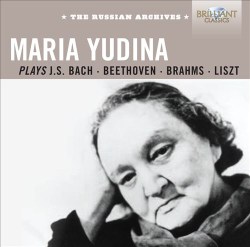
There is a moment in Maria Yudina’s 1948 recording of Bach’s Chromatic Fantasia and Fugue when the fingers seem almost to be dancing — light, skipping, almost mischievous — and you think: this cannot be the same pianist Sviatoslav Richter described as playing Schubert the way a trumpet plays Schubert. But it is. That is precisely the point. Yudina contained multitudes, and not always peacefully.
She was, to put it plainly, one of the most singular pianists of the twentieth century. Not one of the most polished. Not one of the most consistent. One of the most singular. Born into a Jewish family in 1899, she converted to Russian Orthodoxy with the fervor of the genuinely transformed — and that fervor saturated everything she touched, from her personal life to her public recitals, where she might finish a Bartók sonata and then, by way of encore, recite Pasternak aloud to an audience that included, quite possibly, informers. She knew the risks. She took them anyway. The five-year reading ban she received for exactly that kind of audacity was not her only punishment, merely the most famous one.
And yet Stalin loved her playing.
The story is almost too operatic to credit, but it appears to be true: Stalin heard her play Mozart’s Piano Concerto No. 23 in A major on the radio one evening and wanted a copy. No recording existed — it had been a live broadcast. So in the middle of the night, officials woke Yudina, assembled an orchestra, booked a studio. Two conductors reportedly fled the podium, undone by the sheer terror of the assignment. The record was pressed in a single copy and sent to Stalin. According to Shostakovich, it was found on Stalin’s turntable the morning he died.
That story needs to be held in mind as you listen to these Russian Archives recordings, because it illuminates something essential about what Yudina was and what she did. She was not, in any conventional sense, a “luminous” pianist. Richter’s ambivalence was genuine — he admired her enormously and couldn’t quite forgive her for what she did to the Schubert B-flat major sonata, turning it, in his view, into something heroic and declaratory where it should have been inward and autumnal. He was right about what she did. He may have been wrong that she was wrong to do it.
The Bach is the place to begin — 1948, the oldest release here, and in some ways the most surprising. The playing is genuinely gentle, almost airy, with a clarity of articulation that never turns brittle. She floats across the keyboard rather than pressing down into it. There is nothing of the ideological Yudina here, nothing confrontational. Just intelligence and a kind of purity that Glenn Gould — who was seventeen years old when this was recorded — would have recognized immediately, even if he arrived at similar places by entirely different roads.
The Six Preludes and Fugues from the first book of the Well-Tempered Clavier — where she takes them — are another matter. Yudina’s Bach is always personal. That is either its great virtue or its great problem, depending on what you want from the music, and I confess I have not entirely decided. What I can say is that the playing compels attention in the way that only the most individual artists can compel it: you lean forward, you argue back, you cannot be neutral.
Her Weinen, Klagen — the Liszt transcription of Bach’s cantata — is, by all accounts, phenomenal, and the recording supports that judgment. This is music that asks for exactly the kind of spiritual seriousness Yudina brought naturally to everything. The weight of grief in the opening, the eventual transformation toward C major consolation — she navigates it without sentimentality and without the theatrical exaggeration that lesser artists deploy when they want you to know how deeply they feel.
The Schubert is harder to love. Arresting, yes — Richter’s word was exactly right. But there is something almost willful in the way she refuses the sonata’s characteristic harmonic ambiguity, its willingness to hover and dream. Her Schubert is decisive where it should be questioning, bright where it should be shadowed. I understand the interpretation. I don’t quite believe in it. Though I suspect Yudina would have found my objections irrelevant, which is either a mark against her or a mark against me.
What these recordings ultimately document is not a pianist who wanted to serve the music in the manner we have come to expect of the great interpretive tradition — Schnabel’s selflessness, Brendel’s philosophical discipline. Yudina wanted to encounter the music, to wrestle with it. Sometimes she won. Sometimes the music won. The results are almost never boring and occasionally transcendent. In a recorded legacy crowded with pianists of astonishing technical refinement who leave almost no impression on the memory, that is no small thing.
Essential listening — with eyes open.