Grief, it turns out, was Verdi’s great compositional engine. Not religious conviction — he had precious little of that — but grief, fury at mortality, and the particular desolation of outliving the people who had shaped him.
The Messa da Requiem has a prehistory worth knowing. When Rossini died in November 1868, Verdi proposed something extraordinary: that Italian composers pool their efforts and write a collective Requiem in Rossini’s honor, each man contributing one section by lot, none collecting a fee, the finished score to be sealed afterward in the Bologna conservatory like a relic. Verdi drew the “Libera Me.” He wrote it. The project collapsed — he blamed the director Angelo Mariani, his old friend, though perhaps not entirely fairly — and the music sat in a drawer. Then Alessandro Manzoni died in May 1873, and everything changed.
Manzoni. The name needs a moment. Verdi had read I Promessi Sposi at sixteen and never recovered from it. He called it not merely the greatest Italian novel but one of the greatest books the human brain had ever produced — a staggering claim from a man not given to extravagance. He finally met Manzoni in the year of Rossini’s death, the meeting arranged through his wife and his friend Clarina Maffei, and the encounter left him shaken with admiration. When Manzoni fell and died, Verdi couldn’t bring himself to attend the funeral — the shops of Milan were shuttered, thousands lined the streets, the King sent princes — and the grief was so total it became, eventually, music.
That “Libera Me” from the abandoned Rossini project became the seed around which the whole Requiem grew. Which means the work carries two dead men inside it, and a third if you count Verdi’s own mortality — he was sixty when it premiered in May 1874, at the church of San Marco in Milan.
None of this is to say the music is primarily about biography. It isn’t. But knowing it helps explain why the Requiem feels less like liturgy than like theater conducted at the highest possible emotional temperature — which is exactly the accusation Hans von Bülow leveled when he called it “an opera in ecclesiastical vestments.” Verdi, who could be savage in reply, pointed out that he was Italian, and that Italians wrote music differently than Germans, and he was right.
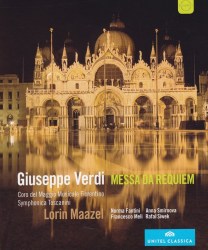
Norma Fantini, Anna Smirnova, and Francesco Meli bring considerable vocal resources to this music. Fantini’s soprano has brightness and weight in useful combination — the “Libera Me” fugue demands both, and she doesn’t flinch when Verdi pushes her into the upper register for those cries that are really a kind of theatrical prayer. Smirnova is a strong presence in the “Agnus Dei,” where mezzo and soprano must breathe together across octaves in that uncanny parallel that sounds like two women singing the same thought from opposite ends of existence. Meli — a lyric tenor of the Italian school, smooth-grained and warm — handles the “Ingemisco” with real feeling, though I wanted slightly more of the desperation the text implies. The “Ingemisco” is a sinner’s plea. It should feel like one.
The “Dies Irae” remains the Everest of the piece, the movement that separates the adequate from the genuinely terrifying. Verdi marks it with bass drum blows that are almost visual — you can see the earth cracking — and the brass choir needs to sound not merely loud but cosmologically final. Conductors who treat the Requiem as a pious exercise miss everything. The movement should feel like the end of the world, because Verdi meant it to.
The competition here is formidable and worth naming. Giulini’s 1963 recording with Schwarzkopf, Ludwig, Gedda, and Ghiaurov remains the benchmark for sheer musical intelligence — the architecture never collapses under the emotional pressure, which is a rarer achievement than it sounds. Solti’s 1977 account is rawer, more operatic in the best sense, with a “Dies Irae” that still makes the hair stand up. More recently, Abbado brought his late-career transparency to the score, and what he found in the quieter passages — the “Lux Aeterna,” especially — was revelatory.
This new disc takes its place in that tradition respectably. Not at the summit — not quite — but with enough commitment and musical seriousness to earn its existence. What it lacks, finally, is the quality hardest to define and easiest to hear: the sense that everyone present understands, in their bones, that this music was written by a man who did not believe in God but was absolutely terrified of death, and wrote his terror down in notes, and called it a prayer.