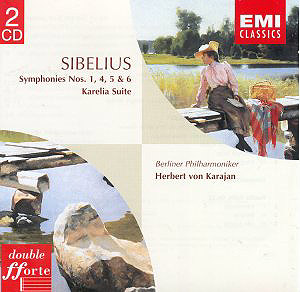
SIBELIUS Symphonies Nos. 1, 4, 5, 6; Karelia Suite (Karajan)
Jean Sibelius (1865-1957)
Berlin PO/Herbert von Karajan
EMI CLASSICS Double Fforte 7243 5 74858 2 (CD1 77.54; CD2 76.35)
Karajan’s Sibelius: The Autocrat in the North
There’s something both fitting and odd about Karajan conducting Sibelius—fitting because both men understood monumentality, how to build structures that seem hewn from granite; odd because Karajan’s sensibility was fundamentally Mediterranean, luxuriant, while Sibelius belongs to those dark Nordic forests where trees grow sparse and light comes slanting through at strange angles.
This EMI set, drawn from sessions spanning nearly a decade, catches Karajan in his full imperial phase with the Berlin Philharmonic. The sound they make together is unmistakable—that burnished, almost too-radiant tone, strings that seem to breathe as one organism, brass that can whisper or blaze without ever quite losing its polish. Whether this serves Sibelius is the question.
The Symphony No. 5 from 1977 is magnificent, though I’d still reach first for his earlier DG account from 1965. Here the final movement’s great horn calls emerge with such inevitability, such weight—you can hear the glacier moving. Karajan understands perfectly how Sibelius builds those long crescendos, the way a single idea gets turned and turned until it catches fire. The Berlin strings in the scherzo-finale’s opening bars achieve that peculiar Nordic shimmer, sunlight on ice. But there’s a trace too much opulence in the slow movement; Sibelius’s austerity gets upholstered.
Symphony No. 4, that bleak masterpiece, fares better. Karajan recorded it in 1978, and here his breadth serves the music—this is a work that needs space, air, the sense of vast distances. The opening’s stark fifths emerge from genuine darkness. I seem to recall his 1960s version moving more swiftly (memory plays tricks after forty years), but this later reading has a gravitas, a willingness to let silences speak, that’s impressive. When the cellos enter at the start of the finale, you hear mortality in the sound.
The First Symphony proves more problematic. Karajan didn’t often program this work—surprising, as you note, given its Tchaikovskian blood and his affinity for the Russian. This 1981 rendition is broad, sometimes too broad. The first movement’s main theme, which should surge forward with youthful impetuosity, gets a bit becalmed. There are wonderful moments—the brass playing is superb throughout, particularly in the finale’s peroration—but the whole doesn’t quite cohere. Perhaps Karajan found the work’s rhetoric, its occasional naïveté, uncongenial. He was never comfortable with unvarnished emotion.
But then comes the Sixth from 1986, and suddenly everything clicks. This most elusive of the symphonies, with its modal harmonies and its refusal of conventional drama, emerges crystalline and deeply moving. Karajan’s structural command serves him beautifully here—he understands how this music unfolds in long, overlapping curves rather than blocks. The first movement’s opening, those strings weaving their polyphonic web, sounds utterly transparent; you can hear each strand. At 4:34 in the first movement, the stereo separation of the string choirs creates an almost physical sense of space—this is engineering from EMI’s best years, and it pays dividends. The finale’s pastoral meditation, which can seem meandering in lesser hands, here feels inevitable, a natural flowering.
Why did Karajan never touch the Third? It’s a genuine mystery. That symphony’s neoclassical clarity, its almost Haydnesque good humor in the finale, should have appealed to him. Perhaps it was too modest, too unpretentious for the image he cultivated. A loss, certainly.
The Karelia Suite (1981) is handsomely done, though this music doesn’t really need Karajan’s level of sophistication. It’s picture-postcard Sibelius, and that’s fine—not everything needs to plumb the depths.
A word about the sound: on headphones, yes, there’s some congestion in the loudest passages, a slight thickening of textures. Through speakers, less bothersome. EMI’s Berlin recordings from this period could be glorious or merely very good; these fall somewhere in between.
Stephen Johnson’s notes provide useful context, though I wish he’d told us more about those 1930s Aachen performances of the Sixth—Karajan at twenty-something conducting that music must have been something to hear.
This is distinguished Sibelius, sometimes great Sibelius, but not quite the last word. For the Fifth and Sixth alone, though, it’s worth having—and at Double Fforte prices, why hesitate? Just don’t expect the raw power of Kajanus or the lean intensity of the best Finnish conductors. This is Sibelius viewed from the center of European culture, admired, respected, even loved—but perhaps never quite understood from the inside.