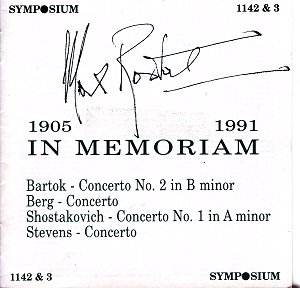
Max Rostal: Concertos by Bartók, Berg, Stevens, and Shostakovich
Max Rostal, violin; various orchestras and conductors
SYMPOSIUM (multiple discs)
Max Rostal: The Teacher Who Played
The pedagogical life and the concert platform—seldom do they coexist comfortably in a single career. One consumes what the other requires. Max Rostal, Carl Flesch’s most distinguished pupil, chose both paths with equal seriousness, and the choice cost him the international celebrity his gifts might otherwise have commanded. But what we have here, rescued from broadcast acetates and preserved with all their sonic limitations intact, suggests something more valuable than another virtuoso’s glittering trajectory: a musician of profound intellectual rigor and unfashionable integrity.
The earliest recording—Bernard Stevens’s Violin Concerto from 1943—emerges through considerable surface noise, the solo violin spotlit with that peculiar BBC forwardness that leaves the orchestra swimming in murk. Yet Rostal’s stentorian opening cuts through, brass punctuating at 4:50, and you hear immediately what made him formidable. This is playing that thinks. The cadenza at 8:50 doesn’t merely display; it excavates the fracture and strain embedded in Stevens’s syntax, a work completed while bombs were still falling on London. The contrapuntal finale suffers from acetate groove damage and orchestral recession, but Rostal’s traversal of the rhythmic material—fractious, occasionally lyrical, never quite consoling—reveals a composer of genuine stature. The Bloch influences are there, certainly, but Stevens’s voice is his own, and Rostal’s advocacy, which extended to editing both this concerto and the earlier Violin Sonata for publication, suggests he recognized something worth preserving.
One wishes the same advocacy had extended to better album conditions. But these are documents, not demonstration discs, and we must take them as we find them.
The Bartók Second Concerto from 1962 shows Rostal at his most characteristic—tonally focused without opulence, intellectually commanding without dryness. The first movement cadenza, which can sprawl into discursiveness, maintains its architectural coherence through sheer concentration of thought. In the slow movement his “flattened” tone (an apt description) emphasizes the music’s quixotic character, and his preparation for the orchestral outburst at 5:10 reveals the kind of structural awareness that separates great musicians from merely competent ones. Listen to the high-lying playing after 10:05, harps and shimmering strings beneath—this is chamber music thinking applied to concerto scale, every detail calibrated, nothing left to chance.
The finale’s motoric complexity, those reflections and refractions of the first movement that Rostal himself notes are “not immediately recognisable as such,” emerges with tremendous clarity. If the tone lacks the voluptuous warmth of, say, Menuhin’s famous recording (and yes, Menuhin did introduce this work to Britain in 1944, whatever Yfrah Neaman claims in his sleeve notes), Rostal’s approach suits Bartók’s astringency better. The sound is muddy, inevitably, but the playing cuts through.
Now the Berg. Herman Scherchen conducting, 1953—a performance of genuine historical significance. Scherchen, who gave the premiere with Louis Krasner after Berg withdrew, brings his characteristic intensity, though the sonic limitations are severe: muddied balancing, acetate thumping, the usual litany of archival woes. But Rostal’s tonal clarity and precision transcend the technical deficiencies. His vibrato usage, sparing and precisely graded, allows the music’s architecture to emerge unadorned. Tempi diverge slightly from what became standard, and there’s an unexpected lightness in places—far from the solemn weight many conductors impose. This isn’t the most emotionally convulsive reading (Krasner’s own preserved rendition with Webern retains that distinction), but it offers an unimpeded view of the score’s construction. Sometimes analytical distance serves music better than emotional immersion.
The Shostakovich First from 1956, with Malcolm Sargent, proves more problematic. The sound is thin and papery—orchestral counter-themes in the first movement simply vanish into the sonic murk. We can hear Rostal’s expressive finger intensifications, his tactical deployment of vibrato, his impressive sense of architectural line. The scherzo taxes him audibly. But in the great Passacaglia I found myself troubled by what seemed over-vibrated playing, as if responding to perceived expectation rather than direct emotional engagement. The movement remained stubbornly remote, its cumulative power unrealized. The Burlesque finale has smeary tone in places, and someone’s botched the CD tracking—it’s marked as track 7 but actually appears as part of the Passacaglia. Small point, perhaps, but symptomatic of the set’s archival nature.
These recordings document a artist who never quite achieved the career his early playing—surprisingly engaged and fiery, according to those who heard him in the 1930s—seemed to promise. Time refined that fire into something more analytical, more focused. Whether this represents artistic maturation or a kind of self-imposed limitation remains an open question. What’s undeniable is Rostal’s contribution to contemporary music—profound, tenacious, eloquent. He advanced composers he believed in (Stevens, Frankel) while baulking at the emerging avant-garde. A man of his generation, in other words, with that generation’s particular mix of openness and resistance.
His teaching legacy—youngest professor at the Berlin Hochschule in his twenties, later at the Guildhall School alongside Albert Sammons and Isolde Menges (and that much-neglected figure Rowsby Woof)—arguably mattered more than his performing career. He discharged his debt to Flesch by transmitting not just artistry but an entire philosophy of violin playing, one that valued intellectual rigor and structural understanding over mere surface brilliance.
This set won’t displace anyone’s favorite recordings of these works. The sonic limitations alone preclude that. But as historical document it’s invaluable—particularly the Stevens, which deserves wider currency, and the Berg with Scherchen. One hopes Rostal’s preserved performance of Frankel’s Violin Concerto will surface eventually. Meanwhile, we have this: a small but considerable legacy from a musician who chose substance over celebrity, and who more than earned his place in the lineage from Flesch forward.
The teaching life and the concert platform. Rostal