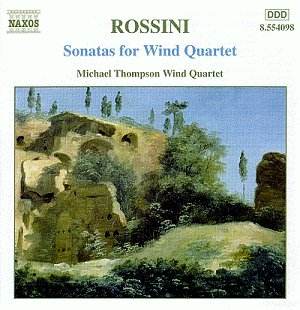
ROSSINI Sonatas for Wind Quartet
Gioachino Rossini (1792-1868)
Michael Thompson Wind Quartet: Michael Thompson [horn], Jonathan Snowden [flute], Robert Hill [clarinet], John Price [bassoon]
NAXOS 8.554098 (68:43)
Rossini’s Juvenilia, Brilliantly Reimagined
Well, here’s a curiosity that works better than it has any right to.
Rossini’s string sonatas—written when he was twelve, for heaven’s sake, in 1804—have been recorded endlessly in their original scoring and in various string orchestra incarnations. But Frédéric Berr’s contemporary wind quartet arrangements? They reveal something essential about these precocious pieces that the strings sometimes obscure. The wit becomes more pointed, the architectural clarity more vivid. Wind timbres, properly deployed, can cut through Rossini’s youthful exuberance with a transparency that strings, for all their warmth, occasionally blur.
Berr knew what he was doing. A distinguished clarinettist who performed in the French premiere of Il viaggio a Reims in June 1825, he understood Rossini’s instrumental imagination from the inside—particularly the composer’s genius for wind writing, which anyone who knows the overtures can appreciate. The voicing here feels utterly natural. Horn takes the cello line without heaviness, flute soars where the first violin sang, clarinet and bassoon fill out the middle voices with conversational ease. It’s skillful work, not mere transcription.
The music itself—well, it’s impossible not to smile. These sonatas overflow with melody, high spirits, and a classical poise that does indeed recall Mozart. Rossini himself dismissed them as “horrendous…composed by me at a most youthful age, when I hadn’t even had a lesson in thorough-bass.” Self-deprecation, of course. The slow movements already hint at the operatic master to come, particularly in their long-breathed melodic paragraphs and theatrical sense of timing.
The Michael Thompson Wind Quartet plays with exceptional unanimity and style. Jonathan Snowden’s flute work in the Third Sonata’s Andante is genuinely lovely—pure tone, elegant phrasing, no affectation. Michael Thompson, whom Naxos has recorded extensively (his Mozart horn concertos are first-rate), anchors the ensemble with burnished sound and unfailing taste. The blend is what impresses most: four distinct personalities that somehow breathe as one.
Robert Hill’s clarinet brings just the right degree of impudence to the faster movements, while John Price’s bassoon provides both foundation and wit. The album, made in St. Paul‘s Church, Rusthall, captures the quartet in warm, immediate sound—close enough to hear the players’ breath, distant enough to preserve the acoustic bloom.
About that Sixth Sonata: Berr assembled it from an existing Andante and theme with variations, possibly from an opera score. It fits seamlessly with the authentic five, which tells you something about Rossini’s consistency of voice even at twelve. The fast-slow-fast structure of each sonata becomes almost ritualistic, yet the invention never flags.
This isn’t profound music. It doesn’t need to be. What it offers is craftsmanship, charm, and—in these wind arrangements—a fresh perspective on familiar material. The performances are exemplary, the recorded sound outstanding, the annotation informative without pedantry.
For Rossini enthusiasts, this disc is essential. For everyone else, it’s a reminder that genius announces itself early, and that good arrangements can illuminate music we thought we already knew. Sixty-eight minutes of pleasure—unassuming, beautifully executed, genuinely delightful.