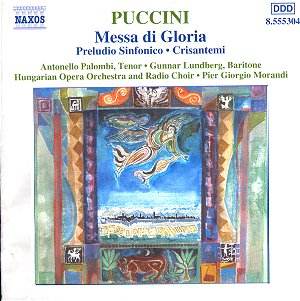
Messa di Gloria; Preludio Sinfonico; Crisantemi
Giacomo Puccini (1858-1924)
Hungarian Opera Orchestra and Radio Choir/Giorgio Morandi; Anotello Palombe (tenor); Gunnar Lundberg (baritone)
NAXOS 8.555304 (59:40)
Puccini: Messa di Gloria, Preludio Sinfonico, Crisantemi**
Hungarian State Opera Orchestra and Radio Choir/Giorgio Morandi
Antonello Palombi, tenor; Gunnar Lundberg, baritone
Naxos 8.555304 [59:40]
The complaint that Puccini’s Messa di Gloria is “too operatic” has always struck me as wonderfully beside the point. Too operatic for whom, exactly? Certainly not for anyone who knows Monteverdi’s Vespers or has heard Cavalli’s ceremonial masses—works that shimmer with theatrical gesture while serving liturgical purpose with perfect propriety. The young Puccini, twenty-two and still a student at the Milan Conservatory when he completed this Mass in 1880, was hardly the first composer to let stage instincts color sacred utterance.
Whether he had yet mastered the balance those earlier masters achieved is another question entirely.
The work lay dormant for seventy years after its premiere, and listening to this committed if somewhat scrappy interpretation from Giorgio Morandi and his Hungarian forces, one understands why Puccini himself never pushed for its revival. The melodic invention is there—unmistakably Puccinian in its suave contours and emotional directness—but the architecture wobbles. The “Gloria” bounces along with an almost Offenbachian spring in its step. Jolly is the word, though perhaps not the first adjective one reaches for in sacred music. The orchestration constantly threatens to overwhelm the choral writing; there are passages where the strings and winds seem to have wandered in from some unwritten operetta, leaving the choir to fend for itself.
Antonello Palombi struggles audibly in “Gratias agimus tibi“—the tessitura sits cruelly high, and his tone thins to a pinched thread above the staff. One winces in sympathy. Gunnar Lundberg fares better; his bass-baritone brings genuine gravity to the “Benedictus,” though even here Puccini can’t resist decorating the vocal line with orchestral filigree that distracts more than it illuminates. The four-part choral singing is accomplished enough, if lacking the last degree of blend and unanimity one hears from the best European choruses.
The “Kyrie” and “Benedictus” offer the most overtly devotional music here—moments where the young composer seems to pause and actually contemplate the texts rather than simply setting them. It’s telling that Puccini found no place for soprano voice in the Mass. For a composer who would go on to write some of the most exquisitely calibrated soprano music in all opera, this seems a curious omission, almost a self-denial.
Preludio Sinfonico and Crisantemi feel like afterthoughts on this disc, though they’re pleasant enough. The Preludio, at just under ten minutes, has the air of an intermezzo still searching for its opera—it’s well-crafted student work, nothing more. Crisantemi, that brief elegy for the Duke of Aosta, possesses genuine poignancy; you can hear Puccini learning to distill emotion into pure string texture. He would later cannibalize it for Manon Lescaut, which tells you something about how seriously he took the distinction between sacred and profane.
The disc, made at Phoenix Studio in Budapest, is clean and well-balanced, though the acoustic lacks warmth—everything sounds a bit dry, a bit matter-of-fact. Naxos’s 30-bit technology delivers clarity at the expense of atmosphere.
This is a valuable document for Puccini completists and for anyone curious about how one of opera’s great melodists learned his craft. But the Messa di Gloria remains what it always was: a talented student’s ambitious exercise, full of luminous moments that never quite cohere into a convincing whole. The performance is serviceable rather than inspired—which may be all this uneven score really needs.