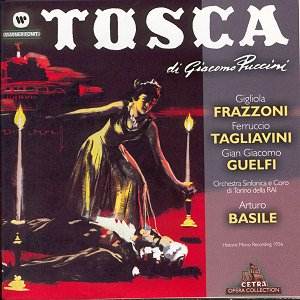
PUCCINI Tosca
Giacomo Puccini (1858-1924)
Gigliola Frazzoni (Tosca), Ferruccio Tagliavini (Cavaradossi), Gian Giacomo Guelfi (Scarpia), Antonio Zerbini (Angelotti), Alfredo Mariotti (Sacrestan), Turin RAI Chorus and Orchestra/Arturo Basile
WARNER FONIT 857387479-2
The old Fonit-Cetra curse—that shrill, edgy sound that made even the finest singing seem like it was being transmitted through a cheese grater. I remember wincing through their issues in the LP era, wondering whether the engineers had actually attended a live performance or just worked from technical specifications. This reissue, happily, shows what decent remastering can accomplish. The voices still sit rather forward in the mix, as if Tosca herself were about to tumble into your lap, but there’s genuine presence here, real dynamic shadings, and—most striking—you can actually hear what Puccini wrote for the orchestra.
Through headphones the improvement becomes even more pronounced. Those shimmering string textures in “E lucevan le stelle,” the sinister brass colorings that shadow Scarpia’s every move—they emerge with remarkable clarity. The orchestra may be pushed back further than modern taste would dictate, but this is 1956, and by those standards the engineering holds up remarkably well.
Now, Tagliavini. Born 1913, debuted in La bohème at Florence in 1938, caught here in 1956 at the absolute peak of his powers before his 1970 retirement. The conventional wisdom pegged him as a tenore di grazia, all honeyed lyricism and elegant phrasing. Well, yes—but listen to how he handles the bigger moments. There’s genuine heft in “Vittoria!” and the voice rings out with clarion strength through the torture scene. What sets this performance apart, though, is the way he finds unexpected intimacy in passages often glossed over. That “Qual occhio al mondo” in Act I—the tone turns golden, almost buttery, without any of the lachrymose self-indulgence that mars so many readings. And the way he shapes “O dolci baci” during “E lucevan le stelle” shows a tenor who’s actually thought about what the words mean, who understands that Cavaradossi is remembering specific physical sensations. The beginning of “O dolci mani” receives similarly honeyed treatment. This isn’t just radiant singing—it’s inhabited, lived-in characterization.
Gigliola Frazzoni presents a more complicated case. Born 1927, La Scala debut in Andrea Chénier the year before this recording, she was one of those singers whose career got crushed under the Callas juggernaut. The story of the aborted 1958 Decca Fanciulla tells you everything about the politics of the time: Votto wanted Frazzoni, Decca insisted on Tebaldi, and we got Franco Capuana conducting in Rome while Votto made his famous chin-stroking gesture—that Italian signal for “What a bore!“—whenever he had to accompany Tebaldi in the theater.
Frazzoni’s voice has the right weight for Tosca, that solid, womanly center that the role demands. More importantly, she’s psychologically acute. The Act I jealousy scene—where Tosca swings from suspicion to tenderness and back again—she catches every shift without telegraphing the transitions. There’s real volatility here, the sense of a woman whose emotions run close to the surface. In Act II she summons the steel the role requires without sacrificing vocal beauty, and the final act finds her genuinely shattered, not just going through the tragic motions. You hear a complete interpretation, thought through from start to finish.
Guelfi’s Scarpia offers traditional virtues without descending into caricature. The voice has fine resonance, that dark baritonal sheen that makes Scarpia’s obsession seem almost plausible—almost. He’s not overtly malevolent in the Gobbi manner, but he doesn’t need to be. The menace is there in the vocal coloring, in the way he shapes certain phrases. It’s an outstanding assumption of the old school.
Two smaller roles deserve mention. Antonio Zerbini’s Angelotti and Alfredo Mariotti’s Sacristan—these are the sorts of comprimario parts that Italian theaters used to fill with real singers, not just warm bodies who could hit the notes. That opening scene crackles with theatrical life because both men bring vocal weight and textual clarity to their exchanges. It’s a reminder of what we’ve lost.
The Turin RAI Orchestra under Arturo Basile—now here’s something worth discussing. During Mario Rossi’s tenure in the 1950s, the Turin orchestra stood apart from its sister ensembles, maintaining genuinely high standards. And Basile (1914–1968, killed in a car crash at fifty-four) represents that now-extinct breed of Italian director who knew how to shape Puccini from the inside. He finds the right ebb and flow, lets the score breathe without wallowing, gives his singers room without letting the dramatic tension slacken. Each act builds with structural inevitability. This is conducting in the Italian mainstream—a tradition that seems to have died with Gavazzeni.
The elephant in the room, of course, is the 1953 Callas/Di Stefano/Gobbi/De Sabata recording, one of Walter Legge’s supreme achievements. That set remains untouchable, a performance of such white-hot theatrical intensity that it transcends the album studio. But must we live only with the Olympian heights? This Turin Tosca offers different virtues—a more lyrical Cavaradossi, a Tosca who’s perhaps more conventionally sympathetic, conducting that emphasizes beauty without sacrificing drama. The sound, while not state-of-the-art, is entirely serviceable, better than many recordings from the same period.
Danilo Prefumo’s notes receive English translation; the libretto appears in Italian only. A minor inconvenience.
This belongs on your shelf alongside the Callas, not instead of it. Tagliavini alone makes it essential for anyone seriously interested in Puccini tenor singing, and Frazzoni deserves to be rescued from obscurity. At superbudget price, the question isn’t whether to buy it but