The Solitary Genius of Conlon Nancarrow
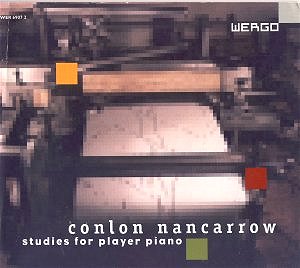
Studies for Player Piano (Complete)
Conlon Nancarrow
Wergo/Harmonia Mundi (5 CDs)
There are musical achievements so singular, so resistant to the usual categories of praise and analysis, that criticism finds itself stammering. What does one say about a composer who spent four decades in exile, punching holes in piano rolls by hand, creating music of such rhythmic complexity that no human performer could possibly play it? Conlon Nancarrow’s complete Studies for Player Piano—all sixty of them, spread across five discs—represents one of the most extraordinary creative obsessions of the twentieth century. And Wergo, bless them, has had the courage and vision to document the entire project with exemplary sound and scholarship.
The biographical outline reads like something from a novel. Texarkana-born, trained by Sessions, Slonimsky, and Piston, Nancarrow fought Franco in Spain, then fled McCarthy’s America for Mexico City in 1940. There he disappeared into a kind of creative monasticism, working in isolation with a medium—the player piano—that freed him from the messy compromises of collaboration. The instrument’s limitations are obvious: a single, unchanging timbre; the mechanical clatter of hammers on strings; the absence of human touch. But for Nancarrow these weren’t limitations at all. They were liberations.
Consider Study 5. Here the pianola becomes a force of nature, a visceral whirlwind of sound in which tone-deadened notes collide with an insistent, pecking cellular motif. The effect is incendiary—there’s no other word for it. Or Study 21, with its chaotic velocity suggesting curtains tormented by gusts of wind, the whole mechanism transformed into what sounds like a vast corrugated xylophone. These aren’t mere technical exercises. They’re revelations of what rhythm can do when untethered from human capability.
The jazz influence runs deep—Armstrong, Bessie Smith, Earl Hines—but filtered through a sensibility that owes as much to Stravinsky and the Baroque masters. Study 2a offers a bluesy saunter down Basin Street, except there are three or four simultaneous hands at work, creating polyrhythmic textures that would have pleased Conlon’s hero Henry Cowell. Study 41c takes ragtime and Gershwiniana and subjects them to a kind of creative decay, loosening the glue that binds these familiar gestures and reordering them with hectic, unpredictable energy. It’s one of the most fascinating studies in the entire cycle.
The range of reference and allusion is staggering. Study 20 suggests plainchant with oriental overtones worthy of Hovhaness. Study 44, at ten minutes the longest on the first disc, presents a gawky promenade with Latino and Caribbean elements—like viewing Copland’s El Salón México through a fragmenting kaleidoscope. Study 26 offers a Gothic meditation in stony, icily ringing cut glass, lamenting and melodramatic. Study 47 recalls Rachmaninov’s Études-Tableaux, bell-tormented but oddly optimistic, picking up earth-shuddering energy as it progresses.
Yet there’s a price to be paid for this rhythmic complexity and timbral uniformity. The sameness of the pianola’s voice becomes, over five hours, a genuine challenge. Nancarrow typically starves his instrument of sustain, concentrating on note patterns rather than resonance. Only rarely—Study 50 is one instance—does he permit the piano to ring out fully. The result can feel claustrophobic, even punishing. One finds oneself longing for dynamic shading, for the touch of human hands on keys, for some relief from the relentless percussive attack.
The Studies also resist easy listening in another sense: they’re fundamentally about process, about the working-out of rhythmic and temporal relationships. Study 48c, with its Webernian fragmentation, suggests random windows onto a conversation, hinting at meaning rather than spelling it out. Study 29, with its morse code dotting and ticking, recalls Bernard Herrmann’s music for The Day the Earth Stood Still—all those radar telescopes scanning the heavens. These are pieces that demand concentration, that refuse to provide conventional satisfactions.
The final study, the three-part Study 49, functions as a kind of concerto for pianola and orchestra—except, of course, there’s no orchestra, only the illusion of one created through rhythmic layering. The first movement hints at Gershwin’s Rhapsody in Blue; the second stalks through mystery and melodrama with a touch of Bach’s Art of Fugue; the third explodes in metropolitan, angst-fueled cross-cutting, rhythmic cells flying like shrapnel. It’s a fitting conclusion to this monumental undertaking.
Wergo’s production is beyond reproach. The sound captures every mechanical detail of the player piano without romanticizing it—this is documentary album of the highest order. The 135-page booklet, with substantial essays by James Tenney and Charles Amirkhanian, provides essential context. One learns about the painstaking process of punching holes in blank rolls, about Nancarrow’s friendships with painters like Juan O’Gorman (whose Aztec calendar mural decorates Mexico City University’s library), about his eventual emergence from isolation in 1981.
Is this music for everyone? Certainly not. It makes severe demands on the listener, and its pleasures are often austere, even forbidding. But for those willing to enter Nancarrow’s world—a world of pure rhythm, of temporal relationships freed from the constraints of human interpretation—these Studies represent an astonishing achievement. They continue the work of Grainger, of Cage, of Emanuel Moor, pushing at the boundaries of what music can be and do.
The set remains an indispensable document of one of the twentieth century’s most original compositional minds. Nancarrow worked in isolation, yes, but he worked with absolute conviction, creating a body of work that still sounds like nothing else. That Harmonia Mundi has made it available in this complete edition is cause for genuine gratitude. This is music that demands to be heard, even if—perhaps especially if—it refuses to comfort or console.