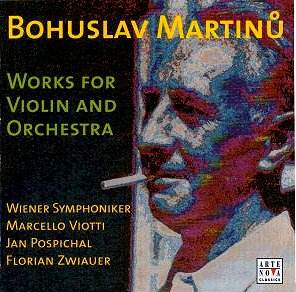
MARTINU Duo Concertant for Two Violins and Orchestra / Violin Concerto No. 2 / Concerto for Two Violins and Orchestra
Bohuslav Martinu (1890-1959)
Jan Pospichal (violin), Florian Zwiauer (violin), Vienna SO/Marcello Viotti
ARTE NOVA 74321 77635 2 (69.24)
Martinů’s Violin Concertos: An Uneven but Rewarding Traversal
Bohuslav Martinů knew what it meant to sit in the section—third desk, second violins, under Talich’s demanding baton. That experience colors everything he wrote for the instrument, though not always to consistent advantage.
This Arte Nova disc brings together three works spanning thirteen years of the composer’s life, from the uneasy pre-war period through American exile to the uncertain 1950s. The programming is shrewd. We get the Duo Concertant (1937), the more familiar Violin Concerto No. 2 (1943), and the Concerto for Two Violins and Orchestra (1950)—a trajectory that maps not just chronology but Martinů’s stylistic evolution from neo-classical gestures toward something more romantically expansive.
The Duo Concertant proves the most problematic. Written in Nice for the Desarzens brothers, it suffers from what one might charitably call—well, let’s be frank: the first movement time-serves. Martinů was capable of better, and he knew it. But then the Adagio arrives, seven and a half minutes of genuinely affecting music that Bach might have recognized in spirit if not in harmonic language. The two violins trace and entwine with tender precision, building to an unexpected frenetic pitch before subsiding into a meditation that fades to nothing. Here’s the Martinů who matters—the one who could spin long lyric lines without sentimentality, who understood how instrumental voices could converse without merely echoing.
Pospichal and Zwiauer navigate this movement with sensitivity, though their tone tends toward the narrow and scorching. One wants more bloom, more tonal warmth—especially in music that lives or dies by the quality of its singing. The recording doesn’t help: claustrophobic proximity in the early going, though Viotti’s Vienna orchestra sounds well-balanced when the engineers finally pull back the microphones.
The finale recovers considerably. There’s a lovely theme around 3:34 that reminds one why Martinů’s best music endures—that peculiar blend of Czech folk inflection and French sophistication, neither quite one thing nor the other but unmistakably his own voice.
The Violin Concerto No. 2, commissioned by Mischa Elman and premiered by Koussevitsky in Boston just before Christmas 1943, inhabits different emotional territory entirely. This is Martinů in his American romantic mode, the style of the great Fourth and Fifth Symphonies. Leaping, tumbling themes rush and slide with luminous lyricism—none of the neo-classical reserve that occasionally constrains the Duo Concertant.
Pospichal opens out here, his tone finally finding the warmth and breadth the music demands. The Andante moderato shows Martinů at his most Dvořákian: listen to the answering sigh of the first violins in that opening dialogue with the winds. No shading of insincerity, no hollow pastiche—just honest, affecting music-making. The composer, dispossessed and exiled, reached for an inclusive emotional palette, and mostly he found what he sought.
Josef Suk’s 1973 Supraphon album with Neumann remains the benchmark, all searing intensity and idiomatic understanding. Louis Kaufmann’s historical performance on Citadel has an edge these players can’t quite match. But this is more than viable—it’s a reading that understands the work’s architecture and emotional contours, even if it doesn’t plumb every depth.
The Concerto for Two Violins and Orchestra, written for the Beal twins and premiered in Dallas in January 1951, splits the difference. Traces of the Duo Concertant‘s desiccation remain, but the prevailing idiom is the neo-romantic impressionism Martinů favored in his symphonic work. The middle movement has a Haydnesque clarity; the finale almost pitches into a foot-tapping rumba before thinking better of it. Of the three works here, this comes closest to the masterly Fourth Symphony in its warmly inventive writing.
The last three minutes are genuinely joyous—sun-warmed tracery and exuberant antiphonal effects that Viotti and his engineers capture with real affection. Both violinists sound more comfortable here than in the earlier work, perhaps because Martinů himself had grown more assured, more willing to trust his instincts.
Marcello Viotti conducts with understanding if not quite distinction. The Vienna Symphony plays well—warm strings, characterful winds—though one occasionally wishes for more incisiveness in the tuttis. The recording quality improves markedly after the Duo Concertant, opening out with welcome generosity.
The notes provide essential information without unnecessary elaboration. At budget price, this disc complements rather than replaces the Supraphon recordings, but it offers music that deserves hearing—especially the two double concertos, which remain shamefully neglected.
Not an unqualified success, then. The performances lack the last degree of tonal beauty and interpretive insight. But anyone who cares for the lyrical-impressionist strain in twentieth-century music will find rewards here. Martinů at three-quarters strength still offers more than most composers at their best.
Recommended, with reservations.