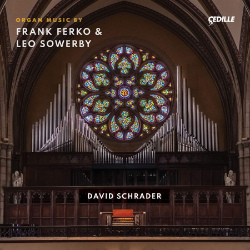
Frank FERKO (b. 1950)
Leo SOWERBY (1895-1968)
Organ Music
David Schrader (organ)
rec. 24-26 August 2019, House of Hope Presbyterian Church, St. Paul (Ferko);
17-20 August 2020, St. Ita’s Catholic Church, Chicago (Sowerby)
CEDILLE RECORDS CDR90000204 [79:25 + 79:04]
The American organ has always occupied an odd corner of our musical consciousness—too grand for the parlor, too churchy for the concert hall, yet capable of extraordinary things when the right composer and player converge. This Cedille release pairs two Chicago-connected composers across a seventy-year span, and the results are more illuminating than one might expect from what could have been a dutiful regional survey.
Frank Ferko’s music here reveals a composer who has thought deeply about color and architecture. The Symphonie brève from 1987 doesn’t apologize for its French sympathies—those modal harmonies and the way he layers registrations suggest someone who knows his Langlais and Messiaen but isn’t enslaved to either. What strikes me most is the structural intelligence: three movements that actually feel brief without seeming truncated, a harder trick than it sounds. The “Variations on a Hungarian Folk Tune” (1994) could have been a Kodály tribute gone stale, but Ferko has the wit to let the material breathe, to find genuine mystery in what might have been mere folkloristic display.
His Mass for Dedication (2002) is the most ambitious work on the disc, and here David Schrader’s interpretive gifts really matter. The House of Hope Presbyterian instrument, captured in 2019, has that particular American brightness—reeds that cut without harshness, foundations that support without mud. Schrader understands that Ferko’s harmonic language, for all its contemporary sophistication, still needs to sing. Listen to how he shapes the long lines in “Communion” from 1995… there’s a meditative quality that never becomes soporific.
Leo Sowerby remains an enigma. Here was a composer who won the Prix de Rome, who wrote prolifically for orchestra and chamber ensembles, yet is remembered (when he’s remembered at all) primarily for his church music. The early “Comes Autumn Time” from 1916 shows a young composer still finding his voice—pleasant enough, with echoes of the English pastoralists, but not yet distinctive.
The 1931 “Pageant” (not to be confused with his later Pageant of Autumn) is another matter entirely. This is Sowerby at full strength: the architecture is solid, the harmonic language richer, more personal. He’d found something by then—a way of being American without resorting to folk-tune quotation or jazz inflections. The 1941 “Toccata” crackles with energy; Schrader recorded it at St. Ita’s in Chicago in 2020, and that instrument’s more focused, slightly drier acoustic suits the music’s motoric drive.
Those “Two Sketches” from 1963 came late in Sowerby’s career, and they’re curious pieces—introspective, almost private. Not the kind of music that announces itself. Schrader plays them with appropriate intimacy, finding the thread that connects these miniatures to the larger works without overstating the case.
What makes this disc valuable isn’t novelty—we’ve had Sowerby recordings before, though not in this particular configuration. It’s Schrader’s musicianship and the intelligent programming. Hearing Ferko and Sowerby in conversation reveals continuities in American organ writing that might otherwise go unnoticed: a certain pragmatic approach to registration, a preference for clear textures even in complex passages, a reluctance to indulge in mere effect.
The engineering serves the music well. Both churches were wisely chosen—the St. Paul acoustic captures Ferko’s more expansive gestures, while St. Ita’s provides the clarity Sowerby’s counterpoint demands. Cedille’s technical team knows these instruments, knows how to place the microphones so we hear the organ in its space without the space overwhelming the organ.
This isn’t a disc that will revolutionize anyone’s understanding of the twentieth-century organ repertoire. But it’s a solid, intelligent contribution to the American organ discography, played with conviction and recorded with care. Schrader makes the best possible case for both composers, and that’s no small achievement.