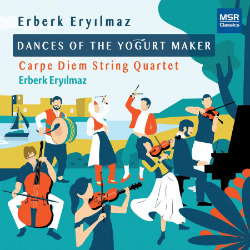
Erberk ERYILMAZ (b. 1989) Dances of the Yoğurt Maker
Erberk Eryilmaz (b. 1989)
Erberk Eryilmaz (darbuka, davul, wooden spoons, piano), Carpe Diem String Quartet
MSR CLASSICS MS1785 (60:11)
A Turkish-American Synthesis That Doesn’t Quite Cohere
The project here is fascinating in conception—and that may be the problem. Erberk Eryilmaz, born in Turkey in 1989 and trained at Carnegie Mellon, wants to marry the intricate rhythmic world of traditional Turkish music with Western string quartet writing. Noble enough. But listening to this MSR Classics release, recorded at Rice University in January 2020, I found myself wondering whether the composer has achieved synthesis or merely juxtaposition.
Dances of the Yoğurt Maker opens the disc with immediate charm. Eryilmaz himself plays darbuka—that goblet-shaped hand drum whose sound world he knows intimately—alongside the Carpe Diem String Quartet, and the piece has an engaging folk-dance energy. The title refers to the yogurt-making process and the drink ayran, which seems whimsical until you hear how Eryilmaz maps the physical gestures of traditional preparation onto rhythmic cells. The strings maintain a drone-based accompaniment while the darbuka chatters away in asymmetrical meters that would have delighted Bartók.
Speaking of whom—Bartók’s shadow looms large here, perhaps too large. Eryilmaz studied with composers who studied with those who remained close to Bartók during his American exile (he died in New York in 1945, not 1940 as some references suggest), and you can hear that lineage in the string writing. But where Bartók achieved an alchemical transformation of folk materials, Eryilmaz often settles for alternation. The quartet plays modal passages derived from maqam scales, then the percussion enters with a different rhythmic language entirely, and the two elements coexist without truly interpenetrating.
“Hoppa! 3,” the longest work here at nearly fourteen minutes, attempts something more ambitious. The piece layers multiple Turkish instruments—davul (bass drum), wooden spoons, darbuka—against the quartet’s increasingly agitated figuration. There are moments of genuine excitement, particularly when Eryilmaz switches between implements mid-phrase, striking the davul with a wooden mallet in one hand while the thin stick creates rapid-fire patterns with the other. The Carpe Diem players attack the syncopations with admirable precision, though I wondered if a bit more rhythmic freedom might have served the music better. This isn’t Beethoven; microscopic ensemble isn’t always the goal.
The two sets of Miniatures (Nos. 4 and 5, from 2012 and 2015 respectively) offer the disc’s most successful music. Shorter forms suit Eryilmaz—he can sketch a melodic idea derived from a maqam, develop it briefly through the quartet’s polyphonic resources, and conclude before the seams show. Set No. 4 includes a lovely slow movement where the cello sustains a pedal point while violin and viola trade ornamented lines that sound almost like a taksim, that improvisatory form central to Turkish classical music. (It’s sometimes transliterated as “taqsim” in Western sources, though “taksim” is closer to current Turkish orthography.) The piano enters unexpectedly—Eryilmaz again—with spare, bell-like figures that suggest neither East nor West but some imagined third space.
Thracian Airs of Besime Sultan takes its title from a historical figure, though Eryilmaz’s program notes don’t clarify which Besime Sultan he means. The music itself evokes the Thracian region’s dance traditions, with their characteristic limping meters—7/8, 9/8, the occasional 11/8. The string quartet handles these well enough, but there’s a certain academic quality to the proceedings, as if we’re hearing a thesis demonstration rather than music that needs to exist. Compare this with, say, the way Ligeti absorbed African rhythmic concepts into his piano etudes—you never feel the join, never sense the composer pointing to his source materials.
The closing Insistent Music lives up to its title. Eryilmaz returns to the darbuka, and the piece builds through repetitive patterns that accumulate hypnotic force. This is minimalism filtered through a Turkish sensibility, and it works—the quartet’s sustained tones create a shimmer against which the drum’s patterns achieve an almost trance-like quality. If the composer had sustained this level of integration throughout the disc, we’d be discussing a major achievement.
The performances are committed, technically assured. The Carpe Diem Quartet, a Houston-based ensemble, clearly spent considerable time with this idiom; their intonation in the maqam-based passages is secure, no mean feat given that these modal systems don’t always map neatly onto equal temperament. The recorded sound captures both the percussive attacks and the strings’ timbral variety, though I’d have liked a bit more air around the instruments in the more nuanced passages.
What we have, finally, is a promising but uneven collection from a composer still finding his voice. The best moments suggest that Eryilmaz possesses both the technical facility and the cultural knowledge to create something genuinely new—a real fusion rather than a polite conversation between traditions. But too often these pieces feel like sketches toward that goal rather than its realization. The disc documents an important artistic journey. Whether it represents a destination is another question entirely.