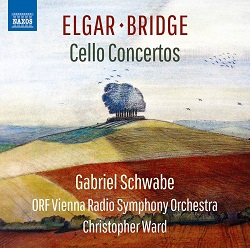
Sir Edward ELGAR (1857-1934)
Cello Concerto in E minor, Op 85 (1919) [26:20]
Frank BRIDGE (1879-1941)
Oration (Concerto elegiaco) (1930) [29:46]
Gabriel Schwabe (cello)
ORF Vienna Radio Symphony Orchestra/Christopher Ward
Rec. 2020, Vienna
NAXOS 8.574320 [56:12]
A Compelling Coupling of War’s Aftermath
What a curious thing, that this coupling—so obvious once you hear it—has been attempted only once before in the catalogue. Raphael Wallfisch recorded both works for Nimbus back in 2006, and now here comes Gabriel Schwabe with the ORF Vienna forces to remind us that these two concertos belong together, bound by grief and memory.
The chronology tells its own story. Elgar’s concerto emerged in 1919, shell-shocked and elegiac. Bridge’s Oration came eleven years later, in 1930, but the wounds were still raw—perhaps even rawer, having had time to fester. Both composers were writing epitaphs for a world that had destroyed itself, though their temperaments couldn’t have been more different. Elgar, the establishment figure, turned inward with a kind of aristocratic melancholy. Bridge, the pacifist who walked Kensington’s streets at 3 a.m. unable to sleep for despair, wrote something closer to a howl of rage.
It’s the Bridge that makes this disc essential. Oration remains criminally neglected—how many cellists even know it exists? The subtitle “Concerto elegiaco” isn’t mere decoration; this is music that functions as funeral oration, the soloist delivering a graveside address that builds from controlled grief to something like fury. The work unfolds in one continuous span, though it falls into discernible sections, and that final epilogue… well, it’s as bleak as anything Vaughan Williams ever wrote. Those closing pages of the Sixth Symphony come to mind immediately.
Schwabe plays his 1695 Guarneri with a tone that’s intensely focused, almost nasal in the upper register—a plangent quality that serves this music beautifully. He understands that every phrase must embody the idea of oration, of public address in the face of unspeakable loss. When the orchestra erupts in violence (and it does, repeatedly), Schwabe responds not with mere virtuosity but with something like moral witness. The great death-march of the Lento section is absolutely shattering here.
Christopher Ward and the Vienna players provide superb support, though I found myself wanting more heft in the biggest orchestral climaxes. Perhaps it’s the album—there’s a certain dryness to the sound that robs the tuttis of their full visceral impact. The Hickox/Gerhardt recording on Chandos has more weight in those moments. But overall? Schwabe and Ward achieve something more devastating, more complete.
A digression, if you’ll permit it. Listening to that death-march in the Bridge, I heard something I’d never quite registered before—the ghost of Britten’s funeral march from the Variations on a Theme of Frank Bridge. Of course we all know that Britten studied with Bridge before entering the RCM. But the stylistic and emotional connection between these two marches is unmistakable. The pupil’s tribute, written in 1936 when he was just 23, already contains the DNA of the teacher’s most powerful utterance. One wonders if Britten knew Oration when he wrote his variations. Surely he must have.
Bridge’s music from the 1920s and early ‘30s—the period when Elizabeth Sprague Coolidge’s patronage freed him to write as he wanted—represents a golden age that we’re only now beginning to properly value. This music was ahead of its time, especially in Britain. It deserves to stand with Britten, Holst, and Vaughan Williams. Recordings like this one help make that case.
The Elgar faces stiffer competition. This may be one of the most recorded concertos in existence, and the ghost of Jacqueline du Pré hovers over every new version. Schwabe wisely doesn’t try to out-emote anyone. His approach is direct, unaffected—qualities that might sound like damning with faint praise but aren’t. He shapes phrases with exquisite sensitivity yet never distorts the music’s flow. That brief Adagio has never sounded more poignant to my ears, precisely because Schwabe refuses to milk it.
This is a tauter, more structurally alert Elgar than we usually hear. Ward and the Vienna orchestra maintain outstanding discipline—the playing is alert, responsive, never slack. When Barbirolli defended the du Pré recording against charges of excess by saying “When you’re young you should have an excess of everything,” he was being characteristically generous. But there’s another kind of truth in restraint, in letting the music’s architecture emerge clearly. Schwabe’s Elgar achieves this without sacrificing emotional engagement. Even that almost unbearably painful coda to the finale retains its musical fluency, its sense of forward motion.
The real accomplishment here is keeping Elgar’s expressive nuances intact while maintaining the underlying flow. It’s harder than it sounds—this music invites you to linger, to savor each phrase’s particular color. Most cellists can’t resist. Schwabe can, and does.
A fine addition to the catalogue, then, and more than that—an important one. The Bridge alone would justify the disc’s existence. That we also get a deeply considered, beautifully played Elgar makes this essential listening. Strongly recommended.