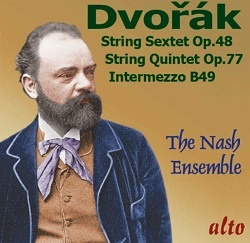
DVOŘÁK String Sextet in A, Op. 48 / String Quintet in G, Op. 77 / Intermezzo in B (The Nash Ensemble)
Antonín Dvořák (1841-1904)
The Nash Ensemble
ALTO ALC1273 (71:33)
The Nash Ensemble has been playing chamber music at the highest level for more than forty years now, and this album from early 2004—why it’s taken so long to come my way I cannot say—reveals exactly why their reputation has remained so solid. These are performances that know what they’re about.
Dvořák’s String Sextet in A, Op. 48, gets the kind of reading that understands the work’s peculiar position in the composer’s output. Written in 1878, the same year as the Serenade for Strings and those glorious Slavonic Dances, it shares their geniality without ever toppling into mere charm. The Nash players—Marianne Thorsen and Laura Samuel, violins; Lawrence Power and Philip Dukes, violas; Paul Watkins and Christopher van Kampen, cellos—bring a unanimity of purpose that never sounds manufactured. Listen to how they shape the first movement’s second theme, that long-limbed melody in the first viola: Power doesn’t grandstand, but he doesn’t disappear either. The balance is exactly right.
What strikes me most forcefully here is the ensemble’s refusal to sentimentalize. The Dumka second movement—marked Poco allegretto—could so easily become cloying in the wrong hands, with all that alternation between melancholy and sudden rustic high spirits. But the Nash players maintain a certain reserve, even in the animated sections. They’re not afraid of silence, of letting phrases end. The poco più mosso episodes have genuine lift without turning into barn dances.
The Furiant third movement crackles. These rhythmic displacements, the hemiola patterns that Dvořák loved so much—they need absolute precision and the kind of collective breathing that comes from musicians who’ve actually listened to each other over decades, not just rehearsed together for a week. The recording, made at St. Jude’s in Hampstead, catches the players in ideal acoustic circumstances. There’s air around the instruments without excessive reverberation.
I’m less convinced by the String Quintet in G, Op. 77, though the reading itself is beyond reproach. The work—earlier than the Sextet by three years—has always seemed to me somewhat diffuse, as if Dvořák hadn’t quite solved the problem of the five-voice texture. That opening movement meanders; even the Nash’s commitment can’t entirely disguise the fact that the thematic material doesn’t bear the weight of development Dvořák tries to load onto it. The Scherzo and Intermezzo fare better. Here the composer’s natural lyricism has room to breathe without pretending to architectural ambitions it can’t sustain.
But then there’s the finale, which nearly redeems everything. The variations on what sounds like a Czech folk song—though I believe Dvořák invented it himself—give us the composer at his most inventive. Power’s viola solo in the sixth variation, all those double-stops, is beautifully done, technically secure but never merely virtuosic. And the ensemble’s handling of the final Allegro molto is exhilarating, the kind of playing where you can hear musicians smiling.
The brief Intermezzo in B that fills out the disc is a curiosity—apparently an alternative slow movement for the Quintet that Dvořák wisely rejected. It’s pleasant enough. Nothing more need be said.
The recorded sound deserves mention: warm without being woolly, detailed without analytical harshness. Alto’s engineering team understood that chamber music of this sort needs a sense of shared space, of musicians in conversation rather than isolated in separate sonic bubbles. The dynamic range is generous; those sudden forte outbursts in the Sextet’s first movement have real impact.
If I have a quibble—and what critic doesn’t?—it’s that occasionally, particularly in the Quintet’s outer movements, the ensemble’s polish verges on blandness. There are moments when I wish for more individual character, more of the slight asynchrony that can make chamber music breathe. But this is a minor reservation. The Nash Ensemble plays with such collective intelligence, such musicality, that one forgives the occasional excess of unanimity.
This disc belongs on the shelf of anyone seriously interested in Dvořák’s chamber music. The Sextet alone justifies the purchase—it’s among the finest recorded performances I know.