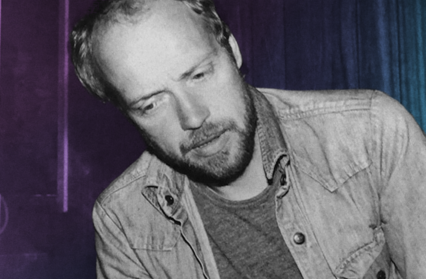
Endaf Emlyn, creator of the first Welsh-language concept album, reflects on his musical career in a conversation with musician and writer Huw Thomas.
Hiraeth. It is a word often misused and commercialised, but the particularly Welsh longing it conjures up has followed much of the work of Endaf Emlyn. For half a century, he has been one of Wales’s most inventive and influential artists. Born in Bangor and raised in Pwllheli, Endaf’s musical talent led him out of North Wales and to Abbey Road and Tiger Bay. In 1974, he recorded the first Welsh-language concept album, Salem, an evocative work that explores the receding world of the chapel through Vosper’s famous painting. However, he has frequently challenged the orthodoxy: during the New Wave era, he delighted and alienated audiences in equal measure with his funk and jazz rock projects. 50 years on from his first album, Endaf speaks about trying “to fill in the gaps in the culture”.
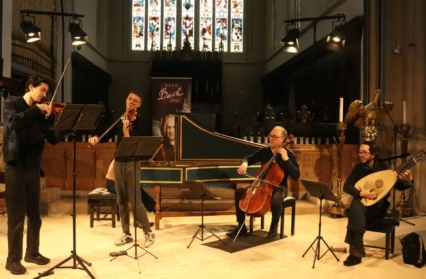
I speak to Endaf Emlyn via Skype and find him sitting in his garden in the sun. He was born in 1944 to a musically-oriented family. “I could sing before I could speak,” he says. “Apparently, I knew loads of carols. My father was a trombone player at one time and my mother sang – everybody sings, of course.” Having been entranced by a string quartet concert at his local village hall, Endaf originally pursued a career as a fiddle player. “My father was very keen on this because he wanted me to carry on where he’d given up, in a sense,” he explains. “I became quite good at it quite soon. I played in the school orchestra and progressed to the National Orchestra of Wales. I was in the National at the same time as John Cale and Karl Jenkins, but I realised I probably wouldn’t get to play the solo as a professional musician. I would be somewhere in the desks of the fiddles. That didn’t seem to work for me, plus I was getting into rock and roll, of course.” Thrilled by Chuck Berry and Elvis, Endaf took up the guitar. At eighteen, he performed a version of “Can’t Help Falling in Love” in a youth club competition judged by folk historian and performer Meredydd Evans. “1962 was a very important year for me,” he remembers. “My mother died and I gave up everything really, I gave up the fiddle. I left home, I went to college and the Beatles came into being. They were doing things with the pop song that hadn’t been done before and that was inspiring.”
It was broadcasting, however, that brought Endaf to national attention. After leaving college, he landed a job as a newsreader for BBC Wales “to general astonishment”. Beginning in 1967, he regularly appeared on Disc a Dawn, Wales’s first pop music programme, presenting a weekly review of UK chart hits. In May 1968, Endaf was announced as one of four initial announcers for Harlech Television (later HTV). In this role, he used a standard received pronunciation accent quite unlike his real voice. “It’s terrible, isn’t it?” Endaf says today. “I used to present stuff haltingly and badly. I had to go for elocution lessons at the BBC because I don’t really have my own natural English accent. Now when I look back, I wish that hadn’t happened.”
Whilst working for HTV as a presenter and floor manager, Endaf followed a parallel career as a musician. In 1971, he signed to M&M Music, Tony Hatch’s publishing company, and recorded his first single, the English-language “Paper Chains”, for Parlophone. Tony Blackburn made the song Record of the Week on BBC Radio 1 but it was the B-side that was more important for Endaf. “I’d asked to do the B-side in Welsh,” he remembers. “’Madryn’ was a song about homesickness, I was sort of displaced and living in Cardiff. It was culturally significant in a way that just another pop song wasn’t. I changed course completely then and that’s what I’ve done since – I’ve tried to fill in the gaps in the culture.” Endaf’s stint with Parlophone lasted for two more English-language singles including the excellent ‘Goodbye “Cherry Lill”’, a Beatlesque piece thick in harmonies and melancholia, and paired him with producer Mike Parker. “He was a guitar player, as far as I knew,” Endaf says. “I went to meet him at Abbey Road and he was sitting at the organ doing all the Brian Auger stuff. He was a multi-instrumentalist, hugely talented, and we got on very well although we were from completely different worlds – he was from Walthamstow, I’m from Pwllheli.”