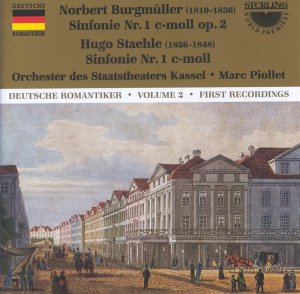
Burgmüller: Symphony no. 1 in C Minor. Staehle: Symphony in C Minor.
Marc Piollet, conductor; Staatsorchester Kassel.
Sterling CDA1234. Recorded [dates, venue]. Booklet notes by Cornelius Grube. CD.
The nineteenth century’s litany of might-have-beens grows longer—and more poignant—with Sterling’s excavation of these two substantial symphonies by composers who barely outlived their majority. Norbert Burgmüller, dead at twenty-six. Hugo Staehle, gone at twenty-two. Both trained under Louis Spohr at Kassel, both steeped in the German Romantic idiom at its most fervently lyrical moment, and both utterly forgotten until Bo Hyttner’s indefatigable archaeological impulses brought them back into earshot.
This is the sort of disc that makes you wonder what else molders in German municipal archives.
Burgmüller’s Symphony no. 1 in C Minor announces itself with a restless, chromatic introduction that owes obvious debts to Beethoven’s Fifth—the same key, the same sense of fate knocking—but quickly reveals a more pliant, Schubertian temperament. The first movement’s second theme blooms with an almost embarrassing sweetness, the kind of unguarded melodic effusion that Mendelssohn would later refine into something more urbane. Marc Piollet and the Kassel orchestra don’t try to impose false grandeur on this music; they let it breathe, accepting its youth and occasional naïveté. The slow movement—marked Andante sostenuto—unfolds with real nobility, the strings spinning long lines that suggest Burgmüller had absorbed the lessons of late Beethoven quartets even as he was writing for full orchestra.
The scherzo crackles with energy, though you can hear the seams where Burgmüller’s ambition slightly exceeds his mastery. Some of the transitions feel manufactured rather than inevitable. But there’s genuine invention in the trio section, where a solo oboe dances against pizzicato strings in a passage that anticipates—uncannily—the woodland murmurs of Schumann’s Second Symphony, written more than a decade later.
Staehle’s Symphony in C Minor operates on a larger canvas, running nearly forty-five minutes and displaying a structural confidence that seems remarkable for a teenager—he was eighteen when he composed it. The opening movement is more overtly dramatic than Burgmüller’s, with explosive dynamic contrasts and a development section that actually develops rather than merely restating themes in different keys. The brass writing shows real flair; Staehle clearly understood how to deploy horns and trombones for maximum impact without overwhelming the texture.
But it’s the Adagio cantabile that justifies this disc’s existence. Here Staehle achieves something genuinely radiant—a sustained meditation built on a simple ascending theme that undergoes gradual transformation over nearly fourteen minutes. The Kassel strings play this with affecting simplicity, resisting any temptation to wallow. There’s a brief passage where the first violins climb into their highest register against sustained wind chords that actually made me sit up and take notice; it’s a sonority I don’t recall hearing in any contemporary symphony.
The scherzo contains some genuinely weird effects—spectral tremolos in the lower strings, sudden silences, eerie woodwind interjections that suggest Staehle knew his Weber. Piollet captures the music’s unsettling quality without exaggerating it. This isn’t Der Freischütz, but it’s working similar territory, that peculiarly German fascination with forest shadows and supernatural dread.
The finale stumbles a bit. Staehle reaches for heroic affirmation—the C minor turns to C major, naturally—but the thematic material isn’t quite strong enough to support the weight he places on it. The coda goes on longer than it should, hammering home a victory that feels more asserted than earned.
Still, these are quibbles. What strikes me most forcefully is how accomplished both symphonies are, how fluently these young composers handled large-scale forms. Neither work is a masterpiece, exactly, but both are substantially more interesting than much of what gets programmed as “neglected Romantics.” The Kassel orchestra plays with evident commitment—the winds are particularly fine, crisp and characterful—and Piollet’s conducting balances affection with clear-eyed assessment. The recorded sound is warm and spacious, capturing the modest-sized ensemble in what sounds like an ideal acoustic.
Sterling’s production values remain exemplary. Cornelius Grube’s liner notes provide essential biographical context without descending into hagiography. He’s honest about these composers’ limitations while making a persuasive case for their historical significance.
Should these symphonies enter the repertoire? Probably not. But they deserve better than oblivion. There’s real music here—lyrical, sometimes inspired, always sincere. And there’s the haunting question of what Burgmüller and Staehle might have accomplished had they lived into middle age. Would either have matched Schumann or Mendelssohn? Impossible to know. But on the evidence of these symphonies, they might well have contributed something valuable to the Romantic canon.
This is more than dutiful musicology. It’s resurrection work worth doing.