
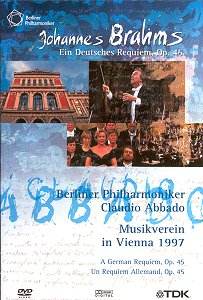
Brahms: Ein deutsches Requiem
Barbara Bonney, soprano; Bryn Terfel, baritone; Swedish Radio Choir; Eric Ericson Chamber Choir; Berlin Philharmonic; Claudio Abbado, conductor.
TDK [catalog number not provided]. Recorded live, 1997, Musikverein, Vienna. No text or translation included. DVD.
The camera work is predictable—too many cello bows, endless rows of soprano mouths frozen mid-vowel—but this 1997 Vienna performance of Brahms’s Ein deutsches Requiem matters for reasons that transcend the medium’s limitations. Claudio Abbado, conducting the Berlin Philharmonic in the Musikverein’s Goldene Saale, achieves something that has eluded many more ostentatiously profound interpreters: he makes this music breathe with an inevitability that feels almost liturgical.
First, the irritations. TDK’s decision to omit both German text and translation is indefensible—a disservice to anyone unfamiliar with Luther’s biblical selections. The diction from the Swedish Radio Choir and Eric Ericson Chamber Choir is admirably clear, yes, but that hardly excuses such commercial shortsightedness.
Abbado has long been accused of coolness, of insufficient emotional engagement—charges I’ve never understood, though I suspect they stem from those who know him only through studio recordings. Watch him here, and the accusation dissolves. Every gesture counts. His balletic economy (never merely choreographic) produces a transparency in Brahms’s contrapuntal writing that reveals architectural clarity without sacrificing warmth. The transition into the fugue of “Herr, lehre doch mich” exemplifies this approach: the chorus enters with a hushed intensity, each voice audible within the texture, yet the cumulative effect suggests vast spaces—death’s dominion, perhaps, viewed from a great distance.
The Berliners sound veiled throughout, darker than usual, though whether this results from Abbado’s restraint or the recording’s sonic profile I cannot entirely determine. Initially I found it puzzling, reached for the treble control. But the text itself suggests a view “through a glass darkly,” and this slightly recessed quality serves Brahms’s purpose. The third movement’s opening, “Herr, lehre doch mich,” emerges from near-silence with a tentative quality—mortality acknowledged but not yet comprehended.
Barbara Bonney’s “Ihr habt nun Traurigkeit” represents the evening’s emotional core. She enters simply, without affectation, and sustains the long melodic arcs with a purity of tone that never becomes merely pretty. The camera wisely stays fixed on her, though the stone-faced altos behind prove distracting. Bryn Terfel, captured here when his voice still possessed that honeyed bloom since lost, sings “Denn alles Fleisch” with appropriate gravity, though I wish he’d inflected the text with greater specificity. He generalizes where Brahms particularizes.
The choral singing throughout tests the limits of human endurance—Ein deutsches Requiem ranks with the Missa Solemnis as the most punishing stamina test in the standard repertoire. That the sopranos can float their long forte line at “Selig sind die Toten” with such impeccable intonation after the exhausting fugue of “Denn wir haben” testifies both to their technical security and to Abbado’s ever-relaxed shoulders, his refusal to drive the music into the ground.
Watch his face during that final fugue. He mouths the words, coaxes rather than commands, and the result—some of the loveliest singing this demanding music has received—justifies his methods completely. The neo-Baroque glories of the Goldene Saale provide an ideal setting, the hall’s warmth and resonance adding another dimension to Brahms’s already richly layered score.
Is this a must-buy? Perhaps not—the video adds relatively little beyond watching Abbado’s artistry, which admittedly offers considerable rewards for those interested in conducting craft. But as a document of a particular interpretive approach, one that prizes clarity and structural coherence over emotional display, it stands as valuable testimony. Abbado reminds us that Brahms, for all his Romantic harmonies, thought like a contrapuntist. The architecture matters as much as the feeling.
The interpretation’s austere beauty lingers. Recommended, with reservations about the presentation.
