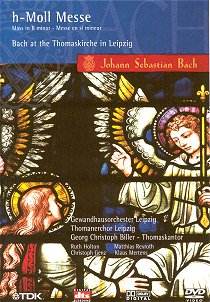
**Bach: *Mass in B Minor***
Ruth Holton, soprano; Matthias Rexroth, countertenor; Christoph Genz, tenor; Klaus Mertens, bass; Gewandhausorchester Leipzig; Thomanerchor; Georg Christoph Biller, conductor.
TDK DV-BAMBM. Recorded live, summer 2000, Thomaskirche, Leipzig. DVD, 114:00.
The Thomaskirche on a summer evening in 2000—Bach’s own church, where the Mass in B Minor surely must have lived in his imagination, if not always in actual performance. One approaches any recording from this venerable space with anticipation. Sometimes unreasonable anticipation.
Georg Christoph Biller leads forces that ought to command this music: the Gewandhausorchester Leipzig, the storied Thomanerchor. On paper, it looks right. In practice, the performance stumbles where it should soar—and it’s the boys who prove the weakest link. Not an easy thing to write about a choir with such history, but there it is. Voices wander sharp, flat, sometimes simply absent while mouths move. The video betrays what audio alone might charitably obscure. These young singers seem adrift in music that demands not just accuracy but comprehension, spiritual weight. They have neither.
The sheer mass of the choir—eighty-plus voices—creates its own problems. Bach’s intricate counterpoint, those marvelous inner voices that should emerge and recede like conversations in a crowded room, simply disappear. The orchestra gets buried. In the “Sanctus,” where instrumental color should blaze through the choral texture, we get instead a kind of undifferentiated roar. Modern instruments played with insufficient transparency.
But the soloists. Here’s where one finds compensation.
Ruth Holton brings her customary intelligence and purity of tone—no vibrato wobble, no interpretive affectation. The “Laudamus te” would benefit from more abandon, perhaps, but her duet with countertenor Matthias Rexroth in the “Christe eleison” achieves genuine beauty. Rexroth himself impresses throughout: his “Agnus Dei” has the requisite pathos, and he navigates the florid passages with a violinist’s agility (speaking of which, that solo violin in “Laudamus te” deserves mention—sparkling indeed, though the camera work frustratingly neglects to identify the player).
Klaus Mertens remains one of our most reliable Bach basses. That voice—dark, focused, never merely booming. His “Et in spiritum sanctum” has the authority of someone who has lived with this music, not just learned it. Every phrase shaped, nothing routine.
Christoph Genz puzzles me. A fine singer on other occasions, here he sounds tired, disengaged. His sole aria, the “Benedictus,” should float with ethereal grace; instead it plods. Perhaps he was unwell. Perhaps the July heat in that church—anyone who has performed there in summer knows the challenge—simply wore him down. Whatever the reason, he’s not at his best.
The sound itself proves adequate without being distinguished. A bit muddy in the densest passages, which the choral imbalance only exacerbates. The video direction shows competence but little imagination—too many lingering shots of the director, not enough attention to the instrumental soloists who deserve their moment.
One wants to celebrate a performance from Leipzig, from Bach’s own forces. History pulls at us. But history isn’t enough, and this performance, hampered by an underprepared choir and questionable balances, never rises to the level this work demands. The soloists offer pleasures—Holton, Rexroth, and Mertens especially—but they can’t redeem the whole. For the Mass in B Minor, look elsewhere.
Richard Dyer