
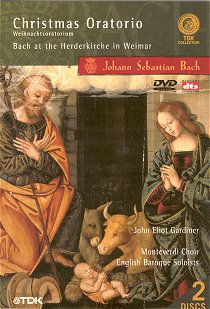
**Bach: *Christmas Oratorio***
Claron McFadden, soprano; Bernarda Fink, alto; Christoph Genz, tenor; Dietrich Henschel, bass; Monteverdi Choir; English Baroque Soloists; John Eliot Gardiner, conductor.
TDK DVD-BACHHO. Recorded December 1999, Herderkirche, Weimar. DVD, 198 min.
John Eliot Gardiner’s Christmas Oratorio was recorded in the Herderkirche, Weimar, on two December days in 1999—just before he launched into that extraordinary, almost quixotic Bach Cantata Pilgrimage that would consume the year 2000. The timing matters. This performance carries the concentrated energy of a project about to begin, the sense of musicians poised at the threshold of something immense.
The Herderkirche provides an ideal acoustic envelope for Bach’s music—not too reverberant, not too dry. Gardiner has always understood that Bach’s vocal works need breathing room but not cathedral wash, and here the balance between the dozen or so instrumentalists and the twenty-voice choir creates an intimacy that larger forces simply cannot achieve. When the opening chorus of Part I erupts with those cascading strings and the choir’s “Jauchzet, frohlocket,” you hear individual threads in the texture rather than a generalized mass of sound. This is Bach at human scale, which paradoxically makes the music more rather than less overwhelming.
The parody question—Bach recycling secular cantata movements for sacred purposes—hardly seems worth raising when the music sounds this inevitable. Did Bach compose “Großer Herr, o starker König” originally for the birthday of some minor Saxon princeling? Perhaps. Does it matter when Dietrich Henschel sings it with such noble bearing? Not remotely. The text fits the music as if predestined, and Henschel’s bass has both the weight and the agility these arias demand. His voice darkens beautifully in the lower register without losing focus.
But it’s Bernarda Fink who becomes the performance’s emotional center. Her “Schlafe, mein Liebster” in Part II—that exquisite cradle song with the rocking siciliano rhythm and Marcel Poncelle’s oboe d’amore winding its melismatic garlands around the voice—achieves a purity of line that makes you forget to breathe. Fink’s alto has unusual clarity in the upper range; she never forces the sound, never pushes for effect. The phrases simply unfold with what seems like complete naturalness, though of course this kind of naturalness requires extraordinary artistry. Listen to how she shapes the long melismas, how the rhythm flexes without ever losing its underlying pulse.
Christoph Genz carries the narrative weight as the Evangelist, and he brings both dramatic urgency and lyric warmth to the recitatives. His tenor has a slightly reedy quality—not a criticism—that cuts through the texture without sounding harsh. In the arias, he scales back appropriately; “Frohe Hirten, eilt, ach eilet” has the right combination of pastoral simplicity and barely contained excitement. Genz understands that not every moment needs to be pushed to maximum intensity.
Claron McFadden gets short shrift from Bach—was the Leipzig soprano really that inadequate?—but she makes the most of her limited opportunities. Her voice has a silvery, slightly vibrato-inflected quality that might not be to everyone’s taste, though it suits the period aesthetic Gardiner cultivates. The brief soprano arias don’t give her much room to develop character, but her “Nur ein Wink von seinen Händen” has appropriate delicacy.
The Monteverdi Choir remains one of Gardiner’s signal achievements. With forces this modest, every singer matters, and the blend he achieves—particularly in the chorales—approaches the ideal of what used to be called “straight tone” singing, though there’s more color and flexibility here than that term suggests. The choir doesn’t sound like a collection of individuals; it sounds like a single, multifaceted instrument. “Wie soll ich dich empfangen” in Part I exemplifies this: the four-part texture emerges with crystalline clarity, each line audible, the harmonic movement tracking Bach’s journey through distant keys with almost physical palpability.
Gardiner’s tempos tend toward the brisk without ever feeling rushed. He understands that Bach’s music generates its own momentum, that the harmonic rhythm and the contrapuntal interplay create forward motion that doesn’t need artificial propulsion. The orchestra—really a chamber ensemble—plays with precision and warmth. Poncelle’s oboe work deserves special mention; his tone has that slightly reedy, poignant quality that modern oboes sometimes lack, and his phrasing matches the singers’ in its flexibility and expressive range.
The two documentaries included here offer genuine insight rather than promotional fluff. Watching Gardiner work through details in rehearsal, hearing him articulate his vision of the Cantata Pilgrimage, visiting the Thomasschule and the churches where Bach worked—all this enriches the experience without overwhelming it. The BBC footage has that slightly grainy, immediate quality that makes you feel you’re actually there rather than watching a polished production.
Technical quibbles? A few. The video direction occasionally gets fussy, cutting away from the music to show atmospheric shots of the church architecture when you’d rather watch the musicians. And while the sound quality is generally distinguished, there are moments—particularly in the larger choral numbers—where the balance tilts slightly too much toward the choir at the expense of the continuo.
But these are minor complaints. This performance stands among the finest recordings of the Christmas Oratorio, and the visual dimension adds something genuinely valuable. You see the concentration on the musicians’ faces, the physical effort of producing this music, the communion between Gardiner and his forces. Sacred music, secular origins, parody procedures—all these scholarly considerations dissolve in the face of music-making this committed and this accomplished. Gardiner’s Bach Pilgrimage would produce many remarkable performances, but this Christmas Oratorio suggests he was already at the peak of his powers before the journey even began.
