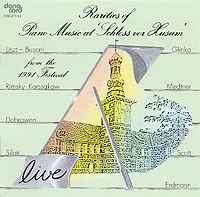
**Treasures from Husum: An Embarrassment of Riches**
This third volume from the 1991 Husum Festival arrives like a time capsule—and what treasures it contains. Danacord’s series has been documenting these recitals for years now, but this particular disc feels especially vital, especially necessary in our current climate of programming timidity.
The opening salvo is simply staggering. Hamish Milne’s performance of Busoni’s transcription of Liszt’s Fantasia and Fugue on the Chorale “Ad nos, ad salutarem undam“ occupies half the disc—thirty minutes—and justifies the purchase price alone. I’ve known the organ original for decades, heard it in countless cathedrals and concert halls. But Busoni’s reimagining, crafted in 1890, doesn’t merely translate Liszt’s 1850 masterwork to the keyboard. It transforms it utterly.
Busoni worked with remarkable freedom here. Bars vanish, new passages materialize, the technical demands multiply exponentially. What was already a monument of nineteenth-century organ literature becomes something else entirely—a piano work of symphonic scope that dwarfs even the B Minor Sonata in its ambitions. The fantasia unfolds with inexorable logic, the "Adagio" breathes with a depth the organ version can only approximate, the fugue builds with cumulative power, and the epilogue—well, the epilogue simply devastates.
Milne understands this completely. His fingers navigate Busoni’s ferocious demands—and they are ferocious, make no mistake—while never losing sight of the architectural grandeur. The pedal points ring with organ-like sonority, yet the inner voices sing with a clarity impossible on Cavaillé-Coll’s grandest instruments. This is piano playing of the highest order, and one wishes the major labels would wake up to what Milne has been quietly accomplishing these past years.
The remainder of the disc offers a fascinating survey of the unfamiliar and the unjustly neglected. Alexander Siloti’s “Complainte,” drawing on Tchaikovsky’s Snegourotschka incidental music, distills pure melancholy into four minutes of exquisite meditation. Siloti—Liszt pupil, Rachmaninoff cousin, maestro of legendary discernment—deserves better than footnote status in music history. This lovely piece, again played by Milne with touching simplicity, makes the case eloquently.
Medtner’s Prelude from the op. 54 Romantic Sketches for the Young presents a curious paradox: music ostensibly written for student hands that somehow captures the essence of Medtner’s mature style in miniature. The harmonic language is unmistakably his—those characteristic modal inflections, the Russian soul filtered through Germanic rigor. Milne, who has become our foremost Medtner advocate (his complete edition for CRD remains indispensable), finds the poetry within the pedagogical framework. One hopes Geoffrey Tozer’s parallel Chandos project will accelerate Medtner’s overdue rehabilitation.
Glinka’s 1847 Barcarolle receives sensitive treatment from Alexei Lyubimov. Yes, one hears John Field’s influence—Glinka studied with the Irish master—but there’s something distinctly Russian emerging in the melodic contours, a quality that transcends the Chopinesque surface elegance. Lyubimov’s nocturnal color suits the music perfectly.
The three Rimsky-Korsakov miniatures, dispatched efficiently by Boris Bloch, confirm what we already knew: this was a composer whose genius resided in orchestral color rather than keyboard idiom. Still, the op. 15, no. 2 Romance possesses genuine charm, its chromatic accompaniment supporting a surprisingly affecting melody. The “Kleines Lied in Dorisch auf ‘e‘” (1901) shows Rimsky-Korsakov experimenting with modal transparency in ways that prefigure his later harmonic adventures. Worth hearing, if not essential.
Issai Dobrowen remains a shadowy figure—conductor of distinction, composer of promise largely unfulfilled. These two pieces from his op. 13, played with conviction by Kolja Lessing, reveal a Scriabinesque sensibility trying to find its own voice. The Prelude hovers between late Romantic chromaticism and something more astringent; the Mazurka-Caprice dances with nervous energy. One would indeed like to hear that Piano Concerto, should anyone be brave enough to program it.
Lessing also tackles Ignace Strasfogel’s 1988–89 "Rondo", a curious neoclassical exercise that name-checks Hindemith and Eisler while maintaining a foot in earlier traditions. Strasfogel studied with Schreker—whose own rehabilitation proceeds glacially—and one senses that lineage in the work’s craftsmanship, if not its aesthetic. An intriguing novelty.
Donna Amato’s performance of Cyril Scott’s “Lotus Land” reminds us why this 1905 piece became a salon favorite—and why Scott’s reputation has suffered accordingly. Yes, the orientalist clichés abound. Yes, the harmonic language borrows liberally from Debussy (though Scott got there first, as the program notes correctly observe). But dismiss this as mere salon fluff and you miss the genuine imagination at work, the subtle voice-leading, the evocative pedal effects. Amato captures the music’s sensuous appeal without wallowing in it. Scott’s larger works—those two piano concertos on Lyrita, the symphonies—deserve serious reconsideration. This miniature won’t convince the skeptics, but it might intrigue them.
Eduard Erdmann’s contributions close the disc with welcome levity. His 1924 Fox Trot, played with infectious energy by Sontraud Speidel, channels Poulenc and Milhaud without mere imitation. The 1915 fugue “Prptilpus“—dedicated to the composer’s cat, complete with performance directions like “creeping” and “crashing“—lasts barely forty seconds but delivers genuine wit. One imagines Grainger would have approved. The vase crashes on cue.
What to make of this collection? The Busoni-Liszt alone would merit strong recommendation. But the cumulative effect of these rarities—some genuinely valuable, others merely curious—creates something more considerable: a portrait of piano repertoire’s vast hinterlands.