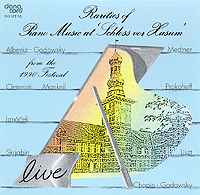
**Treasures from a North German Schloss**
Various composers: ***Treasures from a North German Schloss***.
Performers — Igor Shukow, piano; Claudius Tanski, piano; Janice Weber, piano; Benedikt Koehlen, piano; Bengt Forsberg, piano; Marc-André Hamelin, piano; Geoffrey Douglas Madge, piano; Abbey Simon, piano.
Music & Arts CD-1003. Recorded live, 1990, Husum Festival, Schleswig-Holstein. CD.
The Husum Festival occupies a curious niche in the piano world—part musicological excavation, part virtuoso showcase, staged improbably in a moated castle on the windswept North Sea coast of Schleswig-Holstein. This second volume from the 1990 gathering confirms what the first suggested: that repertoire obsessives and collectors of pianistic exotica have found their spiritual home.
Sixty-five minutes of rarities, yes, though the term wants some qualification. Scriabin’s Polonaise in B Minor, op. 21 isn’t exactly hiding in plain sight—it simply suffers from the fate of all single-movement orphans by composers known for larger structures. Igor Shukow attacks it with the kind of octave work that suggests he’s been living with late Scriabin for decades and has circled back to find this 1897 piece still firmly in Chopin’s orbit. The lyrical episodes bloom naturally, the aggressive outbursts don’t feel manufactured. It’s a difficult work that wears its difficulty lightly in Shukow’s hands, though I’d want to hear more before declaring him the Scriabin specialist the notes claim.
Claudius Tanski’s pairing is more problematic. The “Lento e patetico” from Clementi’s F-sharp Minor Sonata, op. 25, no. 5—a movement “Beethoven ”apparently admired—comes across as a hybrid creature that can’t quite decide if it’s baroque or classical. Tanski plays it respectfully, perhaps too respectfully. One wants more personality, more risk. Then he pivots to Liszt’s Rigoletto paraphrase, and suddenly the temperature rises. Here’s the bel canto singing through impossibly dense figurations, the whole apparatus of midcentury virtuosity deployed with real imagination. The piece may be unfashionable—transcriptions generally are these days—but Tanski makes you forget the cultural politics and simply listen to the piano singing Verdi.
The Liszt continues with Janice Weber’s account of “Aux cyprès de la Villa d’Este II” from the third year of Années de pèlerinage. This is late Liszt, the religious pilgrim replacing the touring virtuoso, and Weber understands the shift. The piece unfolds with a kind of hushed intensity, those cypresses standing as symbols of mourning but also of meditation. It’s not quite as transcendent as the best recordings—I’m thinking of Arrau’s—but it’s thoughtful, beautifully voiced, and it doesn’t overstay its welcome.
Then we arrive at Janáček.
Benedikt Koehlen’s performance of the Sonata “1. X. 1905” is the disc’s centerpiece, and rightly so. This is music born from violence—the bayoneting of František Pavlík during a Czech nationalist demonstration in Brno—and Janáček’s anger and grief saturate every page. Koehlen navigates the first movement’s premonitions and the second’s lament without sentimentality but with enormous feeling. The romantic lyricism never obscures the darkness underneath, and the hope that occasionally surfaces feels earned rather than imposed. We’re fortunate to have this work at all, rescued from the composer’s own destructive impulses by a pianist who made a copy. Koehlen honors that act of preservation.
The Mankell Intermezzo is genuinely bizarre. Henning Mankell—Swedish, virtually unknown, straddling romanticism and something stranger—composed music that a contemporary critic apparently described as falling “somewhere between Brahms and Frank Zappa.” The hyperbole isn’t entirely unwarranted. This little op. 12, no. 2 starts conventionally enough and then seems to slip sideways into tonal regions that feel disoriented, unmoored. Bengt Forsberg plays it as if it makes perfect sense, which is probably the right approach. One emerges wanting to hear more, particularly that Piano Concerto mentioned in the notes.
The Godowsky contingent deserves special attention. Four pieces by the Polish master of transcendental difficulty, each revealing a different facet of his art. Weber’s account of the Schubert-Godowsky “Morgengruß” is charming, technically simpler than most of his output but no less attractive for that. Hamelin tackles Study no. 34 on the Chopin Études—the “Mazurka” based on op. 25, no. 5—with his usual command, though I confess to preferring his complete Hyperion release where these pieces sit in proper context. Geoffrey Douglas Madge contributes “The Musical Clock” from the Triakontameron, though the notes muddle its provenance somewhat. (Is it actually no. 23, “The Musical Box”? The uncertainty is maddening.)
But it’s Abbey Simon’s closing performance of the Godowsky arrangement of “Triana” from Albéniz’s Iberia that stops you cold. The notes quote Sorabji’s astonishing claim that Godowsky’s version “sounds much more like Triana than Triana itself,” and after hearing Simon’s account, you almost believe it. The original emerges “enriched and glorified,” every detail worked out, every cadence granted “subtle modifications of a harmonic or decorative kind.” Simon had just played a full program of Busoni, Chopin, Ravel, and Rachmaninoff—this was an encore—and yet the concentration never wavers. It’s a perfect fusion of two compositional minds, and it makes the case for transcription as a legitimate art form more persuasively than any critical argument could.
The Medtner “Stimmungsbild,” op. 1, no. 4 and Prokofiev’s first “Sarcasm” serve as effective palate cleansers—the former showing the eighteen-year-old composer already in command of mood and atmosphere, the latter demonstrating Prokofiev’s gift for music with two faces, aggressive and tender by turns. Hamelin dispatches the Prokofiev with characteristic brilliance.
Production values are solid, though the recorded sound varies slightly from piece to piece—inevitable given the different pianos and acoustic conditions of a festival setting. The program notes are detailed if occasionally prone to overstatement. (Do we really need to be told that Gradus ad Parnassum will prepare you to “play anything”?)
What we have here is a document of a particular kind of musical culture—one that values the overlooked, the technically formidable.