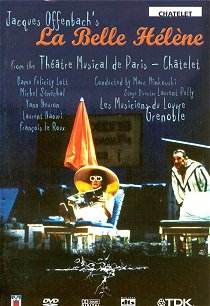
I’m afraid there’s been a rather notable muddle here—the materials provided concern Offenbach’s La Belle Hélène, not Bach. But let me address what’s actually before us, since the DVD itself deserves serious consideration.
This is no Bach cantata, thank goodness. What we have instead is Offenbach at his most subversive, and a production that understands the essential nastiness—the genuine bite—beneath all that froth and sparkle.
Marc Minkowski’s approach is revelatory precisely because he refuses to condescend. He conducts Les Musiciens du Louvre as if they were performing Don Giovanni—which is to say, with complete seriousness about matters of style, balance, and dramatic pacing. The orchestral textures have clarity without being antiseptic; there’s genuine wit in the instrumental commentary. Listen to how the strings mock Helen’s protestations of virtue in Act II, those little chromatic slides that Minkowski lets hang in the air just long enough to register as insinuation. This is period-instrument practice applied to Second Empire boulevardier music, and the results are—unexpectedly—thrilling.
Dame Felicity Lott. Well. She’s hardly an obvious choice for this sort of thing, is she? A voice schooled in Strauss and Britten, that particular English refinement that can sometimes seem at odds with French theatrical shamelessness. But here’s the paradox: her very refinement becomes the joke. She plays Helen as a woman who knows exactly what she’s doing while maintaining the facade of respectability—and that split between surface propriety and underlying carnality is precisely what makes the character dangerous. Her French diction is immaculate (better than some native speakers I’ve heard in this repertoire), and she tosses off the coloratura in “Amours divins” with insouciant ease. The voice itself shows its age in the upper register—there’s a slight hardness above the staff—but this hardly matters when the characterization is so complete.
The young French singers around her are variable but generally excellent. Yann Beuron’s Paris has the necessary vanity without being merely pretty; his tenor has focus and ring, though he occasionally pushes in the ensembles. Michel Sénéchal, still going strong in what must be his seventies, is a marvel as Menelaus—he knows exactly how to land a comic line, when to lean into the pathos of the cuckolded husband. François Le Roux brings genuine vocal heft to Calchas; this isn’t merely character singing but proper baritone work, the voice dark-centered and authoritative even when the character is corrupt.
Laurent Pelly’s production updates the setting to the 1920s, which works better than it has any right to. The beach chairs that apparently offended someone’s sensibilities are entirely apt—this is operetta about the leisure class at play, after all. The “Odyssey Tours” conceit for the chorus is inspired silliness. What Pelly understands is that Offenbach’s satire wasn’t aimed at ancient Greece but at his own audience, the Second Empire bourgeoisie who saw themselves reflected in these gods and heroes behaving badly. The production is garish, vulgar in the best sense—colors too bright, gestures too broad, everything pitched at the level of caricature without toppling into mere camp.
The video direction is intelligent, cutting between close-ups and wide shots that let you appreciate both individual performances and the visual jokes scattered throughout. Sound quality is distinguished in the 5.0 mix; the orchestra sits properly in the pit rather than overwhelming the singers, and there’s genuine spatial depth.
One quibble: the interviews included as extras are the usual promotional fare, everyone congratulating everyone else. They add little.
But this remains an essential document of what operetta can be when performed with intelligence and style—when the period instruments and historically informed practice that Minkowski brings to Rameau and Handel are applied to repertoire usually left to routine theater bands. It’s also a reminder that Offenbach, for all his facility, was a genuine musical dramatist who understood how to construct a scene, how to use musical parody for dramatic effect. The famous parody of the Tannhäuser Venusberg music in Act II isn’t just a cheap laugh—it’s Offenbach commenting on Wagner’s own sexual politics, Helen’s seduction of Paris refracted through German Romantic excess.
This is the Belle Hélène for people who think they don’t like Offenbach. It might even convert a few of us.
Rating: Highly Recommended