# A Tale of Two Concertos
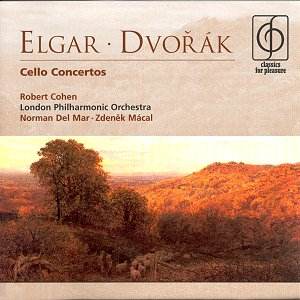
Robert Cohen’s coupling of the Dvořák and Elgar cello concertos—recorded in 1980–81 when the cellist was still in his twenties and poised, we thought then, for something like the career of a Fournier or Starker—makes for curious listening two decades on. The performances reveal a young artist of considerable gifts wrestling with these twin monuments of the repertoire, and the results are… well, uneven.
The Elgar, recorded at Walthamstow Assembly Hall with Norman Del Mar, emerges as something quite special. Cohen’s opening cadenza may lack the gravitas that du Pré brought to those anguished phrases—that bone-deep weariness Elgar poured into the work after the Great War—but there’s a different kind of truth here. The tone is lean, almost ascetic, with a silvery quality in the upper register that suits the music’s autumnal character. Del Mar, who understood British music in his bones, draws playing of rare sensitivity from the LPO. Listen to the way the violas enter after Cohen’s initial statement, or the clarinet’s winding commentary in the slow movement: this is chamber music writ large, and everyone seems to understand it.
The slow movement—marked Adagio—finds Cohen at his most persuasive. He spins out the long melodic lines with genuine eloquence, resisting the temptation to over-romanticize. There’s a quality of restraint here that feels particularly English, though Cohen himself studied with Tortelier. When the music rises to its climactic moments, he has the reserves to make them tell without forcing, without that manufactured intensity one hears from lesser players. The finale’s nervous energy, its inability to settle—Elgar’s own uncertainty about what lay ahead—comes across with real poignancy.
But the Dvořák, recorded a year later with Zdeněk Macal… here’s where things become problematic.
The opening horn call sounds noble enough, and Cohen’s entry is technically secure. Yet something fundamental is missing. This concerto demands a kind of Slavic sweep, a feeling for the music’s epic dimensions—it’s really a symphony with obbligato cello, as has often been noted. Cohen and Macal give us instead something more contained, more polite. The first movement’s great double exposition needs to establish a dramatic tension that will carry through all three movements, but here it feels merely efficient. The orchestral tuttis lack weight; Cohen’s response lacks the requisite passion.
I kept thinking of Rostropovich’s performances—yes, an unfair comparison, perhaps, but unavoidable. Where Rostropovich found tragedy and triumph in equal measure, Cohen offers us well-mannered lyricism. The great second subject, that glorious melody Dvořák marked espressivo, wants to soar; here it merely floats. The technical command is never in question—Cohen’s intonation is secure, his bow arm produces a consistently luminous sound—but the interpretive vision feels incomplete.
The slow movement fares somewhat better. Dvořák’s reminiscence of his song “Lasst mich allein” (written for Josefina Čermáková, the sister of his wife and his first love) emerges with genuine tenderness. Cohen understands the intimacy required here, and Macal scales back the orchestra appropriately. But even this movement, which should break your heart, maintains a certain reserve.
And then the finale—oh dear. This movement needs to feel inevitable, like a force of nature gathering strength. The famous passage where Dvořák quotes the first movement and that song once more, just before the coda, should devastate us with its accumulated emotional weight. Here it registers as merely touching. Cohen plays beautifully, but beauty isn’t enough. The final pages, which should blaze with a kind of defiant affirmation tinged with loss, sound merely vigorous.
The recordings themselves hold up well. Both venues—Watford Town Hall for the Dvořák, Walthamstow for the Elgar—were favorites of British engineers in those years, and rightly so. The sound is warm without being opaque, detailed without harshness. The cello is placed forward but not absurdly so, and the orchestral textures come through with admirable clarity.
At super-budget price, this disc offers value, certainly. The Elgar alone nearly justifies the purchase—it’s a reading that deserves to be better known, one that finds its own path through this inexhaustible score. But the Dvořák disappoints, and in a repertoire so richly served on disc, one can’t quite recommend it over the classic versions. Cohen went on to record both works again, and perhaps found what was missing here. This earlier effort shows us a gifted young cellist who had mastered the notes but not yet plumbed the depths. In the Elgar, that was enough—or nearly so. In the Dvořák, it leaves us wanting more.