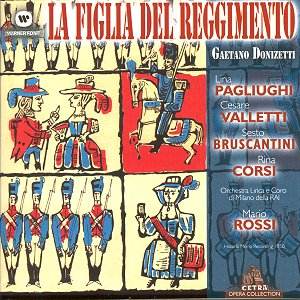
Donizetti: La Figlia del Reggimento**
Lina Pagliughi (soprano), Cesare Valletti (tenor), Sesto Bruscantini (bass), Risa Corsi (mezzo-soprano); Orchestra e Coro di Milano della RAI/Mario Rossi
Warner Fonit 8573 87493–2 (2 CDs, 91:49) Recorded 1950—This 1950 RAI disc catches La Figlia del Reggimento at a curious moment in its performance history—after Toti dal Monte’s brief 1928 revival, before Sutherland made the piece her calling card and transformed it into something closer to a vocal Olympics event. What we have here is leaner, less inflated. More modest, certainly. Whether that constitutes a virtue depends entirely on what you want from Donizetti’s most determinedly frivolous score.
Lina Pagliughi was forty-three when she recorded this—hardly the ingénue Maria is supposed to be, though her voice retains much of its silvery top register and considerable coloratura facility. The trills are clean, the scales mostly even. But there’s a certain primness to her comedy, a reluctance to really dig into the vulgarity that makes this piece work. When she tosses off “Chacun le sait, chacun le dit“—or rather its Italian translation—you hear technical accomplishment without much mischief. The voice itself has that slightly pinched quality common to many sopranos of her generation, a focus that serves the florid writing well enough but denies us the sheer sensual pleasure of a more generously produced tone.
Cesare Valletti, on the other hand, brings exactly the kind of lightness this music demands. His Tonio has elegance—too much, perhaps, for a simple Tyrolean lad besotted with a vivandière. Those high Cs in “Ah! mes amis” (nine of them, if anyone’s counting) emerge with relative ease, though the voice thins noticeably on the last few. Still, there’s genuine charm here, a sweetness of timbre that makes you understand why Maria might actually fall for this fellow. Valletti never forces, never pushes beyond what the voice can comfortably do. It’s intelligent singing, even if it lacks the last degree of élan.
The real treasure is Sesto Bruscantini’s Sulpizio. Here’s a singer who understands that buffo bass doesn’t mean mere bluster—his diction is impeccable, every consonant precisely placed, and he shapes Donizetti’s phrases with genuine musical intelligence. Listen to how he colors individual words, how he varies his dynamics within a single line. This is the work of an artist who would go on to become one of the great comic basses of the century, and even in 1950 the gifts are fully evident.
Risa Corsi makes what she can of the Marchesa di Berkenfield, though the role is essentially a thankless one—Donizetti borrowed the stock Marcellina type from Mozart and gave her precious little interesting music. Corsi sounds matronly enough, which is presumably the point.
Mario Rossi conducts with considerable energy, though the RAI forces aren’t always equal to his intentions. The orchestra plays with spirit but uncertain intonation—those trumpet calls that punctuate the military episodes emerge a bit ragged, and the strings have that slightly undernourished quality typical of Italian radio orchestras of the period. The chorus sounds enthusiastic, if not always precisely together. The “Rataplan” choruses generate genuine excitement, even when the ensemble frays at the edges.
Warner’s remastering is serviceable. The sound is boxy, constricted—what did anyone expect from 1950 Milan?—but voices come through clearly enough, and the orchestral detail is reasonably well captured. There’s persistent hiss, naturally, but nothing that seriously impedes listening.
The cuts to the secco recitatives (added for Italian performances anyway, since the original French version had spoken dialogue) don’t seriously damage the dramatic continuity. This opera’s plot is preposterous regardless—a Swiss regiment, a Countess who turns out to be the heroine’s mother, a Duke of Krakenthorp (really?)—and no amount of recitative will make it less so. Donizetti knew exactly what he was writing: a confection, a vehicle for singers, a piece designed to charm rather than move.
And it does charm, in this rendition at least. Not as brilliantly as later recordings would, not with the vocal fireworks Sutherland and Pavarotti would bring. But there’s something touching about its modesty, its refusal to overstate. These are good singers doing honest work in a piece that rewards both technical skill and theatrical savvy.
At superbudget price, this makes a reasonable supplement to more modern recordings. As a primary recommendation? Probably not—there are simply too many superior versions available. But for those interested in hearing how this opera sounded before it became a showpiece for superhuman vocalism, before Sutherland rediscovered it and transformed performance practice, this 1950 document has genuine historical value. And Bruscantini alone makes it worth hearing.