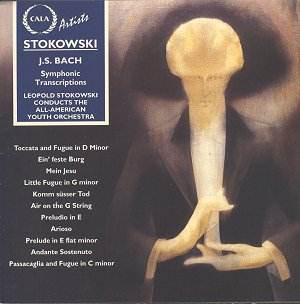
# Stokowski’s Bach: The All-American Youth Orchestra Sessions
These 1940–41 recordings have been around—fragments here, bits there—but never quite like this. CALA’s compilation brings together the entire Bach transcription cycle that Leopold Stokowski made with his All-American Youth Orchestra, and the cumulative effect is rather more compelling than I’d expected.
The orchestra itself was a curious hybrid. Stokowski assembled it from young players nationwide, then stiffened the ensemble with seasoned musicians from Philadelphia. The blend shouldn’t have worked—too many temperaments, too little time—but Stokowski had that uncanny ability to forge a corporate sound from disparate elements. What emerges from these transfers is an orchestra that breathes as one organism, even when the individual voices betray their youth.
Start with the Toccata and Fugue in D minor, BWV 565. Yes, we know it intimately—perhaps too well. But listen past the familiarity to what Stokowski actually achieves with his unorthodox seating plan: woodwinds front and center, strings banished to the rear, brass off to the left. The spatial separation creates these extraordinary gradations between violin choir and brass that simply don’t happen in conventional arrangements. When the fugue subject passes from section to section, you hear it move through physical space, not just through registers.
The slow pieces reveal something else entirely. “Mein Jesu,” BWV 487, unfolds at a tempo so deliberate it risks stasis—but Stokowski’s control of the seamless line never wavers. Each phrase exhales into the next. The portamenti in “Air on the G string” (yes, I know, we’re supposed to sneer at those slides now) are judged with such precision that they enhance rather than sentimentalize. This is where Stokowski’s craft of alternating string and woodwind sections pays particular dividends: the colors shift without disrupting the legato.
I’m less convinced by some of the smaller pieces. The Preludio from the E major Violin Partita, BWV 1006, sounds a touch overweight in full orchestral dress—it wants the transparency that a solo instrument provides. And yet… the "Andante" Sostenuto from the Violin Sonata in A minor, BWV 1003 (Stokowski’s only disc of this transcription) discovers unexpected depths. The string texture progressively lightens through the movement, as if the music itself were dematerializing.
The Passacaglia and Fugue in C minor, BWV 582, serves as the disc’s anchor. Stokowski builds the variations with such architectural clarity that you can hear the structure even as you’re swept up in the emotional trajectory. The brass writing here—those subtle reinforcements, those carefully calibrated additions—shows why his orchestrations remain more than mere curiosities. They’re genuine reimaginings.
Edward Johnson’s notes are authoritative without being pedantic, and there’s a fascinating photograph showing Stokowski’s radical seating arrangement in practice. The transfers themselves are remarkably clean, though you’ll occasionally hear the limitations of 1940–41 recording technology in the upper frequencies.
These performances exist in a complicated historical space. We’ve been taught—rightly, I think—to value Bach’s original instrumental specifications, to respect the music’s lean contrapuntal textures. Stokowski’s approach represents everything we’re supposed to have moved beyond: the Romantic inflation of Baroque restraint, the maestro as co-creator rather than faithful servant.
And yet these recordings retain their power. They’re not authentic Bach—let’s dispense with that pretense immediately. They’re Stokowski’s Bach, filtered through an aesthetic sensibility that valued sonorous beauty and emotional immediacy above historical fidelity. Judge them on those terms and they succeed brilliantly.
The Columbia engineers captured a warmer, more rounded sound than RCA typically achieved with Stokowski, and the All-American Youth Orchestra plays with an enthusiasm that occasionally edges toward impetuosity—but that raw energy serves this music well. These aren’t the polished, rather impersonal remakes Stokowski would make in stereo decades later. They have grit.
Do we need another Stokowski Bach transcription disc? Probably not. But this particular disc, gathering these specific performances in this particular sound… it makes a case for itself. For those who already treasure Stokowski’s Bach, it’s essential. For skeptics, it won’t convert you. For the curious, it offers a remarkably vivid document of a vanished approach to music-making—one that prioritized beauty and emotional truth over scholarly correctness.
I keep returning to that photograph of the unorthodox seating arrangement. It’s a perfect metaphor for Stokowski himself: convinced that conventional wisdom was merely convention, willing to rebuild from first principles, utterly confident in his own musical instincts. These recordings capture that confidence at its peak.