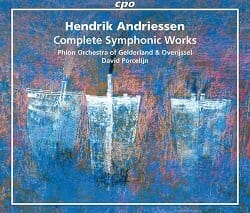
HENDRIK ANDRIESSEN (1892-1981): Complete Symphonic Works
Phion Band of Gelderland & Overijssel/David Porcelijn
CPO 555 508-2 [4 CDs: 226:34]
Some forty-five years ago, in a sleepy Pennine village church where the choir outnumbered the congregation by a ratio of roughly ten to one (Easter and Christmas excepted), I encountered Hendrik Andriessen’s Sonata di Chiesa for the first time. Our long-suffering organist—a talented fellow who took advantage of meagre attendances to experiment with contemporary repertoire—had acquired the score during a visit to Utrecht Cathedral. He played it regularly, cleverly exploiting its theme-and-variation structure to try out the most daring registrations our decrepit instrument would allow.
I remember turning up to practice one evening to hear our curate (of decidedly traditionalist leanings) admonishing the poor man: “Wesley… YES!! Handel…
YES!!! Bach… YES!!!
(dramatic pause) MESS-EYE-EN… NO!!!” before stomping red-faced down from the organ loft. On another memorable occasion, this same cleric picked up a copy of the Good News Bible from the pulpit, raised it aloft theatrically, and spat out “This is the Word of the Devil!!” before hurling it across the nave.
We never saw him again. The congregation—a pair of elderly ladies—were clearly nonplussed. But the Sonata di Chiesa remained, providing the soundtrack to my time in that choir.
Thus commenced my interest in this much underrated Dutch composer, practically unknown in Britain at the time. Many decades later his younger son Louis (who passed away earlier this year) would achieve international stature that surely would have made his father proud. This most desirable box from CPO brings together four discs issued individually over recent years, — each containing one of Hendrik Andriessen’s four symphonies accompanied by a selection of other orchestral works.
None of this music is unsubstantial. All of it is very fine indeed. The Symphony No.
1, completed in 1930, is at thirteen minutes an unusually concise distillation of sketches drawn up throughout the previous decade. It incorporates a three-movement fast-slow-fast design within a continuous span, though a puckish "scherzo" is embedded within the central panel. Its pensive opening seems to contain the seeds of all that follows—if the quicker music seems neo-classical in pace, its melodic and — well — harmonic content projects a more serious tone (Rousselian rather than Stravinskian, perhaps) than that descriptor might imply.
This is superb work. Not a note, colour, or gesture is miscalculated. David Porcelijn absolutely has the measure of its shape and seriousness, drawing playing from the Phion Orchestra that combines precision with genuine emotional engagement.
It amounts to far more than the sum of its parts. The Symphony No. 2 was composed in 1937 to mark the fiftieth anniversary of the Concertgebouw, dedicated; to Eduard van Beinum, who conducted that orchestra at its premiere the following year.
Andriessen retained a tripartite plan but here each movement embodies a discrete form—Fantasia, Pavane, "Rondo"—though the composer’s economy of means remains mightily impressive. This tautly cogent utterance is done and dusted within nineteen fascinating minutes. The tight harmony and sinuous melodic writing at the outset of the Fantasia is markedly different from the language of the First Symphony.
Leo Samama suggests that Andriessen’s Parisian adventures during the twenties impacted upon the bitonality which flavours this music, but I hear something more akin to Willem Pijper’s second and third symphonies in its sheer sound. The central Pavane is more diatonic and rhythmically predictable until some unusual syncopations towards its conclusion—Andriessen’s writing for woodwind is wonderfully variegated here, the timbral palette shifting with almost impressionistic delicacy. The "Rondo" "finale" returns to the mysterious, occasionally ominous atmosphere of the first movement.
One cannot be anything but impressed by this composer’s absolutely non-tokenistic deployment of saxophones, appearing in beautifully judged cameos at key points. By now it becomes apparent that Porcelijn’s accounts are far superior in every way to their comparatively workmanlike (and rather dated) counterparts on Etcetera, not least in terms of CPO’s warm and detailed sonics. The Enschede venue provides just enough ambience without blurring inner detail.
Andriessen was detained for six months during 1942 by the occupying Nazi forces for his non-cooperation but was still able to continue in his professional roles. He picked up the thread of his symphonic cycle following the war’s conclusion with his Symphony No. 3 in 1946.
The opening bars of this elegant four-movement work briefly suggest something more affirmative in spirit than its predecessors, though this is qualified by terse reminders of what has passed, with modal inflections that aren’t a million miles from the music Vaughan Williams was writing at the time. Andriessen seems to be alluding to a period of emotional regrouping in this Ouverture, paving the way for the positive spirit to truly begin in the motoric Sonata second movement. Once again this composer’s fastidious craftsmanship is on show in every bar—in my view an omnipresent quality in all his music.
The emotional core lies in a haunting, nostalgic Sarabande which projects hints of the distant past through baroque patternings and intermittent brass fanfares, all underpinned by an uneasy gravity that is powerfully affecting. Listen to how the woodwinds enter at 4:23, like memories surfacing unbidden. The stylistic and emotional questions posed by these three movements are resolved in a concise Fuga "finale" which is simultaneously gritty, architecturally ingenious, and deeply satisfying.
Porcelijn leads an account that is invigorating and engaged—the antithesis of a routine run-through. By the time of his Symphony No. 4 of 1954, in keeping with contemporaries such as Frank Martin, Andriessen felt it his solemn duty to derive some constructive application from the dodecaphony still influential at that point, though like Martin he rejected outright its implied emotional coldness.
You can almost hear the rosin dust settling on the strings.
At twenty-five minutes his final attempt at the form was his most extended, though he reverted to his earlier preference