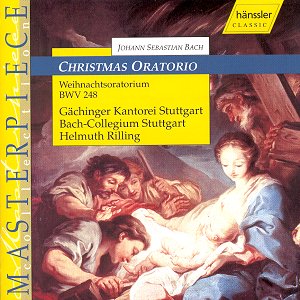
 Johann Sebastian Bach
Christmas Oratorio, BWV 248
Arleen Auger (soprano), Julia Hamari (contralto), Peter Schreier (tenor), Wolfgang Schöne (bass)
Gächinger Kantorei Stuttgart, Bach-Collegium Stuttgart / Helmuth Rilling
Recorded April/July 1984, Gedächtniskirche, Stuttgart
Hänssler Classic CD 94.010 [3 CDs: 57:27, 47:49, 49:18]
Helmuth Rilling’s Christmas Oratorio is a landmark post-war Bach album—its pedigree almost self-evident, given Rilling’s towering Bach discography and his founding of the Gächinger Kantorei in the early 1950s. This set, recorded at Stuttgart’s Gedächtniskirche, features a cast of soloists who, by the mid-1980s, had become synonymous with Rilling’s Bach sound: Auger, Hamari, Schreier, and Schöne. Together, they negotiate this sprawling, festive masterpiece with a clarity and precision that remains admirable.
The textures here are notably transparent—Rilling’s leanings toward modern instruments do not betray the piece’s baroque origins but instead offer a well-lit, almost clinical cleanliness. The strings, for instance, are crisply articulated, every semiquaver sharply etched. Trumpets blaze in the high tessitura with a brightness that, while exhilarating, can verge on the brittle, particularly in the jubilant choruses that open and close various parts.
Take the chorus that launches Part V: it positively crackles with rhythmic tautness; yet, as it unfolds, the relentless, percussive quavers lose their elasticity, becoming a sequence of discrete, isolated notes rather than a flowing, dance-like momentum. It is a curiously mechanical effect—sprung rhythm without swing—and it begs the question: does such exactitude enhance the festive spirit, or rather impede the music’s natural breath and pulse? The chorales, too, present an intriguing conundrum.
Rendered with admirable textual clarity and note-to-note fidelity, they eschew the long, tender legato lines that one might instinctively associate with congregational singing or baroque vocalism. This “note-perfect” approach seems, paradoxically, to rob the chorales of their inherent warmth and communal resonance. One imagines the early-morning bathroom singer—those casual, untrained, but honest bursts of legato phrasing—and wonders if Rilling’s fastidiousness might be, in a way, counterintuitive to the music’s deeply human core.
Yet not all is rigidity or overprecision. There are moments—especially in Part IV, the F major “maestoso” section—where the tempi relax, allowing a more spacious, almost reverent sense of drama to emerge. Here, Rilling’s sensitivity as a director shines.
The accompanied recitatives, in particular, receive nuanced support; the continuo and strings interact with the soloists not as mere accompaniment but as active shapers of mood and narrative. Julia Hamari’s third aria, “Bereite dich, Zion,” is a highlight—her legato phrasing and warm timbre find a perfect partner in Rilling’s sensitive orchestral textures, producing one of the few genuinely classic moments on this disc. Peter Schreier’s performance as the Evangelist remains, as ever, a model of clarity and expressive nuance.
His tenorial emission is free, effortlessly clear even in the punishingly high recitative passages. Every phrase is shaped with a natural ebb and flow, never losing sight of the text’s dramatic significance. Schreier’s arias, such as “Frohe Hirten, eilt, ach eilet,” sparkle with joyous agility and impeccable diction.
In contrast, Wolfgang Schöne’s bass—who perhaps shares Rilling’s own penchant for sharply articulated phrasing—can sound a touch overprecise. His recitative “Immanuel, o süsses Wort” is almost metronomic, each note neatly punched out but lacking the warmth one might hope for. Moreover, his swift passages tend toward overaspiration, lending an unintended pantomimic edge to a voice otherwise endowed with real beauty.
Arleen Auger, sadly no longer with us, turns in an interpretation tinged with both elegance and frustration. Her role in the Christmas Oratorio is limited, but in the aria “Nur ein Wink von seinen Händen,” marked largo e staccato in the Urtext, she navigates an unusual challenge—staccato phrasing at a tempo slower than some “"allegro"”s heard elsewhere in the work. Auger meets the demand gamely, though the effect is odd and perhaps a misreading of the score’s spirit.
This points to a broader issue—the tension between scholarly exactitude and expressive freedom that pervades much of Rilling’s approach. It is tempting—perhaps too easy—to dismiss these interpretative choices as relics of a generation caught between the romantics’ lush legato and the period-instrument revolution’s stark clarity. Rilling and his contemporaries sought to strip away excess Romanticism but perhaps swung too far in the opposite direction, sometimes forgetting that Bach’s music, while structurally rigorous, breathes with a profoundly human and vocal sensibility.
The company’s articulation aims for precision but occasionally lapses into a somewhat “railway track” effect, where every note clicks into place without the subtle shaping that might evoke the music’s spiritual depths. Still, this set offers undeniable virtues: a generally robust vitality, crystalline recording quality, and soloists who—save for moments of rigidity—bring a wealth of experience and insight to the table. For those seeking a clear, clean, and respectful account of the Christmas Oratorio on modern instruments, Rilling’s 1984 Stuttgart performance remains a touchstone.
Yet, if you crave something that stirs more profoundly—something that embraces the legato pulse, the organic ebb and flow of phrasing, and the heartfelt warmth that lies beneath Bach’s architectural brilliance—you might find this offering wanting. In the end, Rilling’s Christmas Oratorio is a beautifully wrought, if somewhat restrained, proclamation of Bach’s festive masterpiece. It is a reminder that technical mastery alone, even when informed by decades of scholarship, cannot fully capture the mystery or the joy that anchors this music at the heart of Western spiritual experience.
Is it enough? For some listeners—certainly. For others—those who live for the sigh between notes, the nuanced inflection that turns a phrase into a prayer—it may fall just short of the sublime.