WAGNER Tannhäuser
Richard Wagner (1813-1883)
Robert Dean Smith, Nina Stemme, Marina Prudenskaya, Christian Gerhaher, Albert Dohmen, Peter Sonn, Bianca Reim, Rundfunkchor Berlin, Rundfunk-Sinfonieorchester Berlin, Marek Janowski
PENTATONE PTC5186405 (55:09 + 65:13 + 50:25)
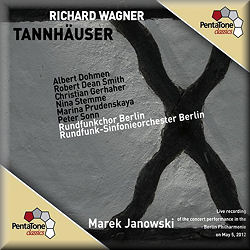
Janowski’s Tannhäuser has arrived to complicate my reservations about his ongoing Wagner cycle — and I mean that as a compliment. The earlier installments left me admiring the engineering more than the music-making, but this one is different. Something has caught fire.
Start with the tenor. Smith is an outstanding singer — I want to say that plainly before I say anything else — but Tannhäuser is arguably the cruelest role Wagner ever devised for the voice, and it exposes a certain want of sensuous ease in his lower-middle register that matters enormously in the Venusberg music. When Tannhäuser is bewitched, you need to hear why. Smith doesn’t quite seduce you there. What he does have, in formidable abundance, is heroic thrust — the kind of ringing, committed tone that makes the Rome Narration something genuinely harrowing. His “verdammt” lands like a fist. And the final act’s spiritual collapse, the bewildered exhaustion in his voice when Wolfram fails to recognize him, is vocally acted with uncommon intelligence. He’s not Peter Seiffert, whose disc with Barenboim remains the benchmark for me, but he dispatches the role with real distinction — which, for this particular Everest of a part, is saying quite a lot.
Nina Stemme’s Elisabeth is a revelation. Not a girlish one — there’s nothing remotely girlish about Stemme — but a princess who actually seems conscious of her station. The regal weight in her voice, that burnished, slightly imperious quality, reframes the character entirely. “Dich teure Halle” is thrilling from the first phrase, the winds’ flickering sixteenth-note figures underneath her like nervous excitement given orchestral form, and her Act 3 prayer carries a spiritual gravity that’s genuinely affecting. She holds the phrase without forcing it, which is harder than it sounds.
Marina Prudenskaya is the right kind of Venus — darkly gorgeous in timbre, genuinely dangerous. Where so many mezzos push too hard for the seductive effect and end up merely strident, Prudenskaya trusts the voice. In Act 3 she turns up like something half-remembered and half-desired, and it works.
The comprimario casting is strong throughout. Albert Dohmen’s Landgraf has an imposing, somewhat gruff authority that suits the character’s ceremonial weight better than more polished baritones sometimes do. Wilhelm Schwinghammer’s Biterolf carries a useful edge of real contempt. Bianca Reim’s Shepherd is brief and lovely.
But Wolfram — well. Whoever sings Wolfram here nearly runs off with the whole production, and that’s where this review must, frustratingly, break off. Stay tuned.