CHOPIN Piano Sonatas Nos. 1, 2 & 3 (Eugéne Mursky)
Frédéric Chopin (1810-1849)
Eugéne Mursky, piano
Profil Edition Günter Hänssler PH04074 (79:16)
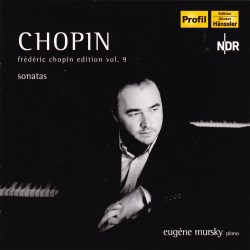
Eugène Mursky was born in Tashkent in 1975, and there’s something in his musical formation — that particular blend of Soviet rigor and cosmopolitan freedom — that seems to have prepared him unusually well for this Chopin project. Hänssler commissioned him to record the complete piano works in commemoration of the composer’s 200th birthday, and nine volumes in, Mursky sounds less like a pianist working through an assignment than one who has found his natural habitat.
The disc itself deserves a word. Cool, transparent, vividly focused — you hear fingers on keys, not a digitally smoothed abstraction of piano playing.
Chopin was eighteen when he completed Piano Sonata No. 1 in C Minor, Op. 4, though the work sat unpublished until two years after his death. Understandable, perhaps — this is early Chopin, still wrestling with the formal demands of the academic sonata, and the seams occasionally show. But Mursky finds what’s genuinely alive in it. The opening is wild, restless, and he plays it that way, without apology. The “Menuetto” arrives with a lightness that feels exactly right — graceful rather than merely pretty. And in the “Larghetto,” something more tender surfaces, a quality almost of private grief, before the finale breaks loose with the kind of headstrong energy a teenager might actually have felt writing it.
Piano Sonata No. 2 in B-flat Minor needs no introduction. The “Marche funèbre” — composed two years before the rest of the sonata, in 1837, which always strikes me as a strange compositional fact worth remembering — has been recorded so many times that a pianist really has to mean it. Mursky means it. His phrasing is spacious without being inflated, his tone in the central section genuinely consoling rather than merely hushed. The opening movement has real conviction and dazzle, and the “Scherzo” moves with the kind of effortless virtuosity that conceals how murderous the passage work actually is. The finale — that brief, spectral whisper of a movement — lands with the right combination of velocity and mystery.
Piano Sonata No. 3 in B Minor is the one that tends to get overlooked, unfairly, because it lives in the shadow of its more famous predecessor. Mursky does it justice. The “Allegro maestoso” is long, episodic, demanding — and he navigates it through lightness of touch and unusually fluid phrasing, finding intimacy where lesser pianists find only rhetoric. The “Scherzo” is bold but controlled, not the kind of brute-force approach that misreads Chopin’s dynamic markings as invitations to pound. Then the “Largo” — one of Chopin’s most exquisite slow movements, frankly — played here with a delicacy that borders on the fragile without ever losing its shape. The “Presto ma non tanto” finale is unerring.
Among the recordings I return to: Rubinstein’s accounts of the Second and Third Sonatas, made at the Manhattan Center in 1961, remain touchstones — that singing tone, the absolute naturalness of the rubato. Pollini’s 1984 Herkulessaal recordings are something else entirely, architectural and ice-clear, extraordinary musicianship of a different temperature. Mursky doesn’t displace either. But he belongs in the conversation — which, for a Chopin sonata cycle, is saying something real.
This is a pianist born to play this music. Simple as that.